Approx. 3-minute read
My LinkedIn feed is flooded with articles and graphics predicting the end of the HR function. AI will automate the processes, answer the questions and analyse the workforce. The implication? HR will no longer be needed.
I need to challenge that.
Change, yes. End, no.
HR should expect scrutiny of its cost, capability and contribution. Tasks will disappear. Roles will evolve. Processes that no longer add value should go. Automating activities still leaves decisions about purpose, priorities and accountability.
I’m going to be bold with this next statement. But I’m going there anyway…
Are we applying the same thinking to other C-suite roles? CFOs? CEOs? CTOs?
WILL WE NO LONGER NEED A CFO BECAUSE NUMBERS CAN BE AUTOMATED?
Technology can process transactions, consolidate accounts and generate forecasts. But who challenges the assumptions? Who decides whether to preserve cash, pursue an acquisition or fund expansion? Who weighs the return against the risk the business can afford?
A forecast can model a decision. Someone must take responsibility for committing the capital.
WILL WE NO LONGER NEED A CEO BECAUSE AI CAN PRODUCE A STRATEGY?
A system can analyse markets, model scenarios and recommend a direction. But who decides which opportunity deserves commitment? Who brings investors, customers and employees with them? Who recognises when to persist, pivot or walk away?
Leadership involves making choices with incomplete information and owning the consequences.
WILL WE NO LONGER NEED A CTO BECAUSE CODE CAN INCREASINGLY WRITE ITSELF?
AI can accelerate development. But who decides what should be built? Who assesses architecture, security, integration and maintenance costs? Who challenges whether faster delivery creates customer value or accumulates technical debt?
SO WHY ASSUME THAT AUTOMATING HR TASKS REMOVES THE NEED FOR PEOPLE LEADERSHIP?
A system can draft policies, analyse applications and generate organisation charts. But does the business need more headcount or clearer accountability? Can its leaders deliver the growth plan? Will a restructure improve performance or remove expertise that protects revenue?
These are commercial decisions with human consequences.
LET’S TAKE A MOMENT AND LOOK BACK 100 YEARS
Mass production and mechanisation transformed output, jobs and skills. Electrification reshaped factories, homes and daily life. Computers and automation changed manufacturing, accounting, payroll and administration.
The internet and email accelerated communication and opened global markets. Smartphones and cloud technology connected teams across locations and time zones.
Global mobility expanded access to careers and talent. Organisations had to bring different cultures, expectations and working practices together.
Then Covid disrupted established ways of working almost overnight. Leaders had to protect people, maintain operations and make decisions through extraordinary uncertainty.
Technology enabled connection. People made that connection work.
Change, change, change. The only thing guaranteed is change.
AI brings another substantial chapter. Businesses should improve productivity, reduce administration and make better use of expertise. That includes HR.
“People will always need people” cannot defend every existing role or management layer. Seniority offers no automatic protection.
Nor will human judgement always outperform machines. People make poor decisions, resist evidence and misuse power. Experience does not make someone infallible.
The objective is to combine capabilities, test decision quality and make responsibility clear. Oversight requires people with the understanding, time and authority to challenge an output. A rubber stamp gives little protection.
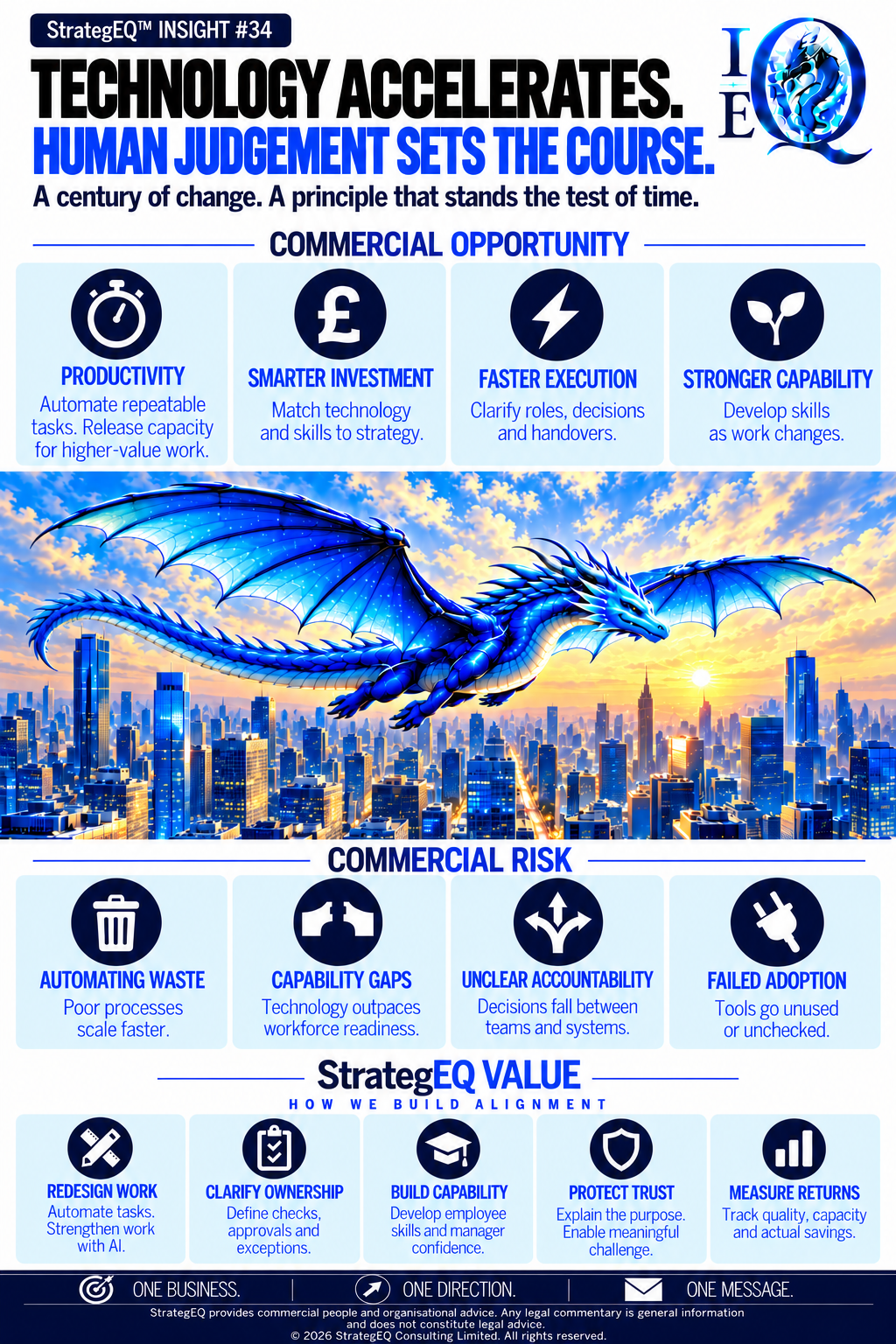
StrategEQ VALUE – HOW WE BUILD ALIGNMENT
- REDESIGN WORK: decide which tasks to automate, which to strengthen with AI, and where human decisions remain essential.
- CLARIFY ACCOUNTABILITY: establish who checks outputs, approves consequential decisions and handles exceptions.
- BUILD CAPABILITY: develop employees’ skills and managers’ confidence as responsibilities change.
- PROTECT TRUST: explain the purpose of change and give people a meaningful route to challenge decisions.
- MEASURE REALISED VALUE: assess quality, capacity, customer outcomes and actual savings alongside adoption.
Implementation alone does not demonstrate a return. Time released becomes valuable when the business uses that capacity effectively.
People leadership must connect workforce choices to growth, productivity, risk and return. So must every CXO.
Technology accelerates. Human judgement sets the course.
Acceleration creates value when the organisation knows where it is going and retains the capability and authority to change course.
People will still need people. They will also need evidence, challenge and accountability.