
Approx. 3-minute read
Businesses recruit for different perspectives, experience and judgement. Those differences can strengthen decisions, challenge assumptions and build customer relationships. Yet some organisations recruit individuality and then reward conformity.
Others move too far in the opposite direction. “Bring your authentic self” becomes permission to say anything, disregard boundaries or defend damaging behaviour with “That’s just how I am.”
Both approaches carry a commercial cost. One suppresses contribution. The other undermines trust, collaboration and accountability. The opportunity is to create an environment where people can be themselves while taking responsibility for how they work with others.
AUTHENTICITY, INTEGRITY AND JUDGEMENT WORK TOGETHER
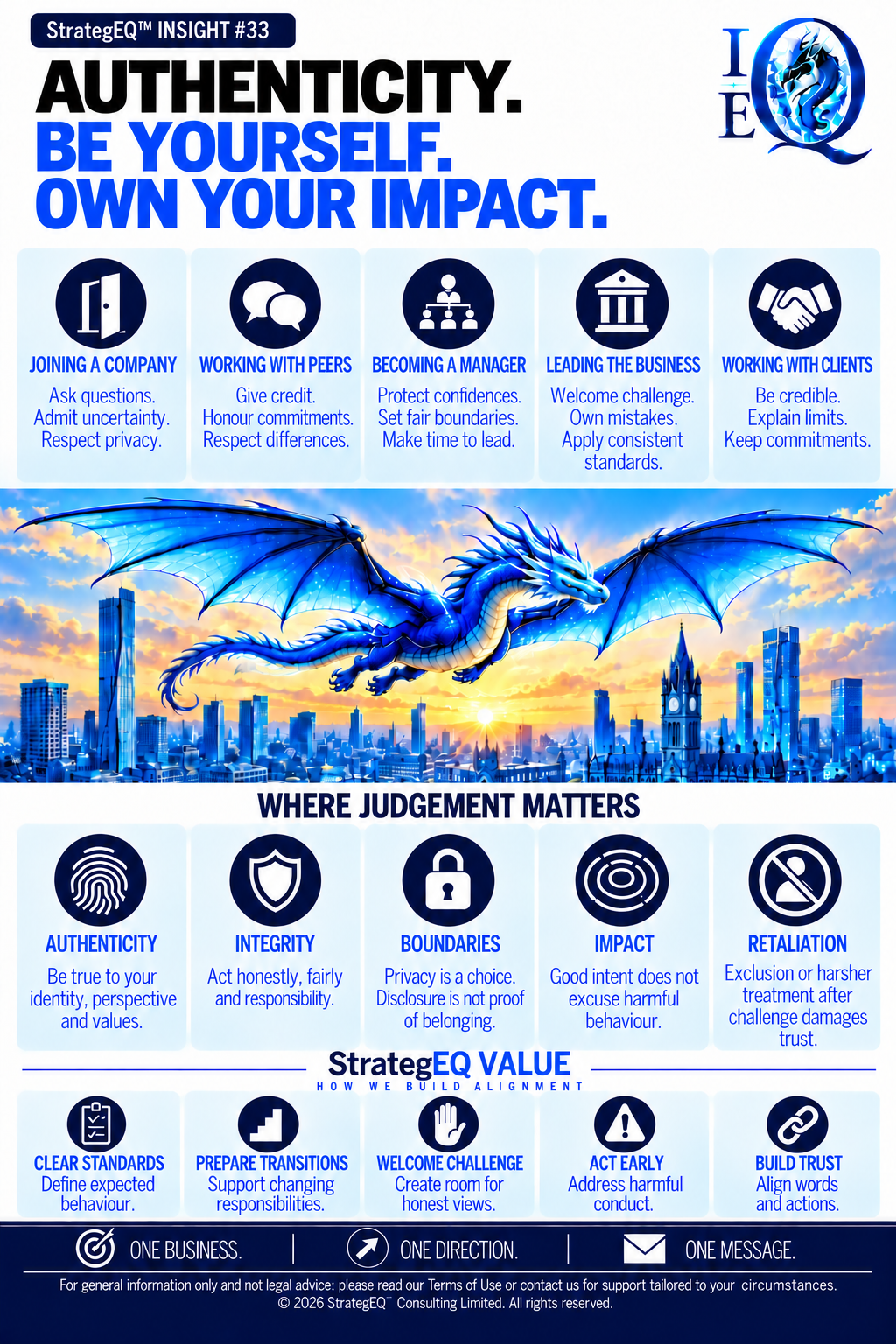
Authenticity means being true to your identity, perspective and values. Integrity concerns how you act: honestly, fairly and responsibly, including when doing so is uncomfortable. Judgement helps you decide what to share, how to communicate and which boundaries the situation requires.
The standard should be clear: people do not need to disclose everything about themselves to belong, and sincerity does not excuse harmful conduct.
JOINING A COMPANY: UNDERSTAND THE ENVIRONMENT WITHOUT DISAPPEARING INTO IT
For someone entering working life or joining a new business, authenticity involves balancing contribution with learning. They need to understand expectations, relationships and ways of working while bringing the perspective they were hired to contribute.
Culture, age, gender, sexual orientation, religion, disability and life experience can influence how someone experiences work. Nobody should have to offer personal information as proof of openness or commitment.
Welcome questions and uncertainty. A useful starting point is:
- Make expectations explicit rather than relying on unwritten rules.
- Welcome different perspectives and communication styles.
- Respect privacy and individual choices about disclosure.
- Explain the reasoning behind established ways of working.
WORKING WITH PEERS: DIFFERENCE NEEDS MUTUAL RESPONSIBILITY
Authenticity within a team is tested through everyday behaviour. Giving credit, honouring commitments, sharing information and handling disagreement all influence whether colleagues trust each other.
Being direct can be valuable. It still requires consideration of timing, language and impact. Humour may strengthen relationships, but familiarity does not guarantee that everyone experiences the same comment in the same way.
BECOMING A MANAGER: RELATIONSHIPS CHANGE AND BOUNDARIES MATTER
The move from peer to manager adds authority, confidential information and responsibility for other people’s opportunities. Informal comments and personal preferences can now carry greater weight.
A new manager can remain warm, candid and recognisably themselves while adapting how they operate. They must protect confidences, avoid favouritism and hold necessary conversations with former peers.
Authenticity should support credible leadership. It should not become a reason to share someone else’s information, avoid difficult feedback or expect employees to carry the manager’s frustrations.
LEADERSHIP AND EXECUTIVE TEAMS: GREATER AUTHORITY INCREASES THE IMPACT
Senior leaders shape what people believe is acceptable. Their responses to disagreement can determine whether useful information reaches the decision-making table.
Credibility grows when leaders acknowledge uncertainty, explain decisions and own mistakes. It weakens when confidence becomes certainty, challenge becomes disloyalty or personal preference becomes the company standard.
Leaders can be transparent without sharing everything. Confidentiality, commercial sensitivity and responsibility for others require judgement. The important question is whether they communicate honestly within those boundaries.
WORKING WITH CLIENTS: BE REAL AND COMMERCIALLY RESPONSIBLE
Clients value credibility. That includes clear communication about capability, limitations, commitments and delivery.
Adapting to a client’s context is part of professional judgement. It does not require inventing a personality or agreeing with everything they say. Equally, authenticity does not justify unnecessary personal disclosure, dismissive language or promises the business cannot fulfil.
RECOGNISE HARMFUL BEHAVIOUR WITHOUT DIAGNOSING PERSONALITIES
Focus on observable conduct rather than labelling somebody “toxic”. Repeated humiliation, exclusion, withheld information, credit-taking and inconsistent treatment can damage both people and delivery.
Retaliation deserves particular attention. After someone challenges a decision, do they suddenly lose access, opportunities or support? Does scrutiny become harsher without a clear explanation?
Examine evidence and patterns. Set expectations, provide a safe reporting route and address conduct consistently. Strong results or seniority should not protect someone from accountability.
StrategEQ VALUE
Build clear standards, prepare people for changing responsibilities, welcome constructive challenge, act early on harmful conduct and align words with actions.
Be yourself. Respect boundaries. Own your impact.