
Approx. 3-minute read
Your next grievance may arrive with a chronology, policy references and a detailed legal argument. Your disciplinary decision may be tested against the contract before the meeting has finished.
The information advantage has changed. Employers cannot assume that HR is the only source of employment knowledge in the room.
An employee can use AI to examine documents, organise evidence and prepare an appeal. That does not make the output correct. It does make access to a structured challenge faster and easier.
The commercial question is whether the underlying decision can withstand scrutiny.
INFORMATION IS MORE ACCESSIBLE. JUDGEMENT STILL MATTERS.
We have discussed recruitment becoming, at times, a conversation between systems: AI reshapes a job description, AI maps a CV, and another system assesses the match.
The same dynamic can extend into employee relations. A manager uses AI to draft a letter. An employee uses AI to challenge it. Both documents sound authoritative. Neither establishes what actually happened or whether the response was fair.
AI can identify an overlooked issue. It can also misread a clause, apply the wrong legal test or invent a reference. Employers must assess the concern on its merits, rather than dismiss it because AI helped write it.
Equally, an employee should not have to produce a polished legal submission to be heard. The standard of the writing must not determine the seriousness with which a concern is treated.
THE EXPOSURE IS COMMERCIAL
Ministry of Justice figures show single Employment Tribunal claim receipts increased by 28% in April–June 2026 compared with the same quarter in 2025, reaching approximately 14,000. These figures cover Great Britain and measure claims received, not claims won. They do not establish that AI caused the increase.
The legal framework is changing too. From 1 January 2027, the qualifying period for ordinary unfair dismissal protection is scheduled to fall from two years to six months, with the compensatory award cap removed.
That makes preparation a current management priority. It does not mean every dismissal becomes unlawful, or that every procedural error produces a successful claim.
In applicable cases, an unreasonable failure to follow the Acas disciplinary and grievance Code can increase compensation by up to 25%. Sound process supports decisions; it cannot rescue an outcome unsupported by the facts.
The cost starts well before a hearing. Leadership time is diverted. Managers become cautious or defensive. Working relationships deteriorate. Delivery slows while the business investigates events that should have been addressed earlier.
BETTER INFORMATION SHOULD IMPROVE THE CONVERSATION
Employees understanding their rights is a positive development. A genuine concern identified early gives the business an opportunity to act before harm grows.
The challenge is to distinguish substance from confident presentation, recognise patterns and respond consistently. A grievance is information to investigate, rather than proof of wrongdoing or evidence of disloyalty.
This requires managers who can listen, explain expectations and recognise when specialist input is needed. It requires records that show the reasoning behind a decision, rather than a retrospective attempt to justify it.
Policies must reflect what happens in practice. A thoughtful handbook offers little protection if different teams apply different standards or employees cannot raise concerns safely.
A clear decision trail helps the next manager better understand the context, and avoid past mistakes.
StrategEQ VALUE – HOW WE BUILD ALIGNMENT
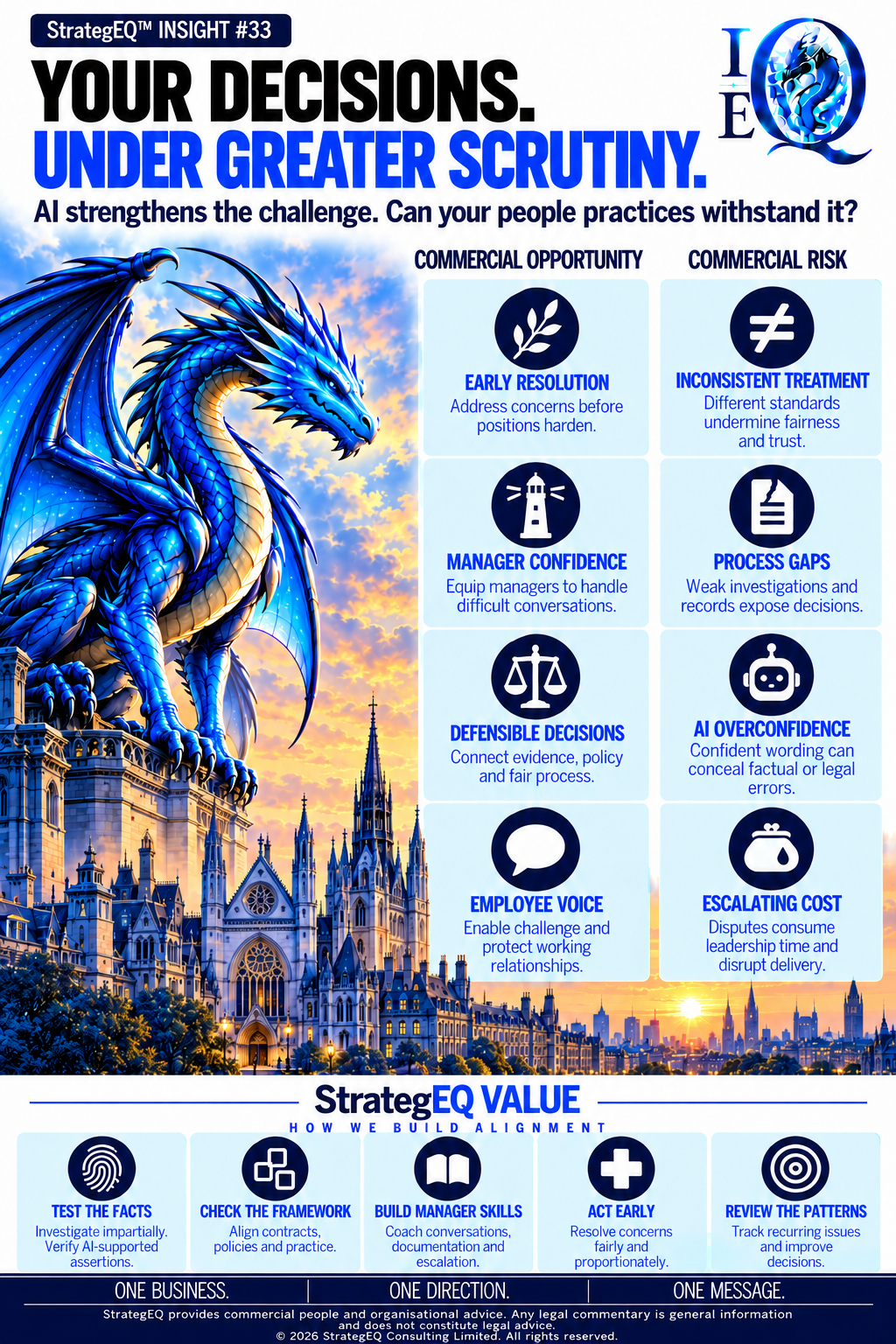
- TEST THE FACTS: support impartial investigations, establish clear chronologies and verify factual or legal assertions generated with AI.
- CHECK THE FRAMEWORK: review how contracts, policies and day-to-day practice fit together. Identify inconsistencies before managers rely on them.
- BUILD MANAGER SKILLS: develop confidence in performance conversations, documentation and fair decision-making. Make escalation routes clear.
- ACT EARLY: address concerns promptly and proportionately. Use informal resolution where appropriate, with formal processes when required.
- REVIEW THE PATTERNS: examine recurring grievances, appeals and management issues. Use the findings to improve how the organisation works.
Experienced People support can bring commercial context, practical judgement and consistent handling. Specialist employment legal advice belongs alongside it where the circumstances require that expertise.
Technology can strengthen a challenge. It can also strengthen the quality of an employer’s preparation and response.
The objective is to make sound decisions, explain them clearly and correct mistakes when the evidence demands it.
Your decisions are under greater scrutiny. Build the capability to make them worthy of that scrutiny.
Sources
- Ministry of Justice, Tribunal Statistics Quarterly: April to June 2026, published 10 September 2026
- Government implementation timetable: six-month ordinary unfair dismissal qualifying period and uncapped compensatory awards from 1 January 2027 (forthcoming at the date of this article)
- Acas Code of Practice on disciplinary and grievance procedures
- Acas consultation: Code of Practice on disciplinary and grievance procedures 2026