
Approx. 5-minute read
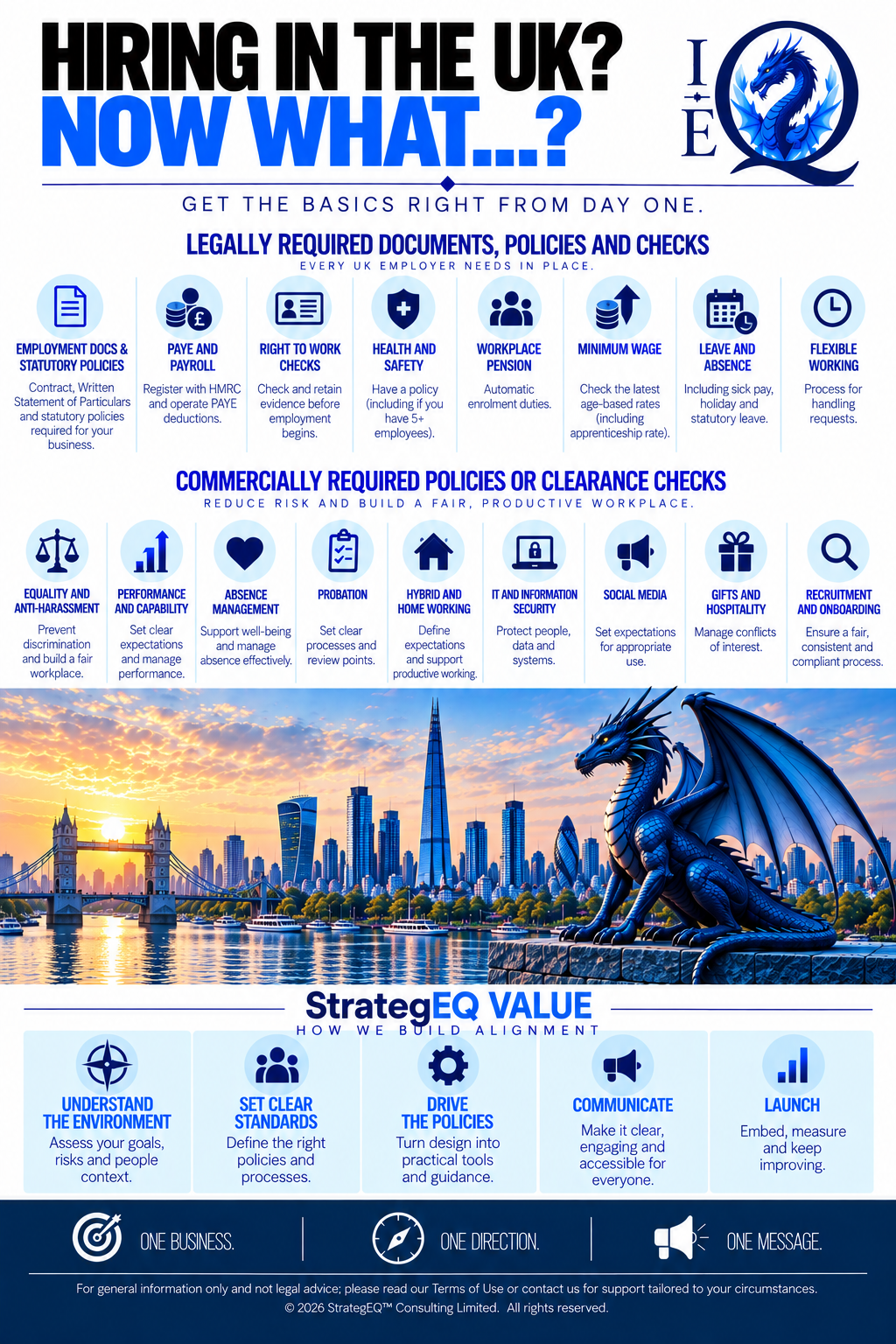
Hiring your first UK employee creates more than a recruitment requirement.
It creates an employer.
And getting the foundations right early is considerably easier and cheaper than trying to retrofit them once the company has grown.
WHY DOES IT MATTER COMMERCIALLY?
For a startup, scale-up or international company establishing a UK team, the objective is not to create unnecessary People infrastructure. It is to make sure the basics are right so the business can hire and grow without accumulating avoidable risk.
Getting those foundations wrong can create:
- payroll and tax problems;
- pension compliance issues;
- illegal-working exposure;
- employment disputes;
- inconsistent contractual terms;
- health and safety liabilities;
- poorly controlled employee data;
- contractor and IR35 risk; and
- issues that surface during investment, acquisition or due diligence.
The principle is simple: you do not need everything on day one, but you do need the essentials.
WHAT NEEDS TO BE IN PLACE?
EMPLOYMENT DOCUMENTATION
Employees need compliant written particulars of employment, with the principal statement provided from day one.
Documentation should accurately reflect the relationship you intend to create, including:
- role and responsibilities;
- pay;
- working hours;
- holiday;
- place of work;
- probation;
- notice; and
- other required employment particulars.
Consider whether the role also requires appropriate provisions covering confidentiality, intellectual property, remote or hybrid working, post-termination restrictions or international working.
The contract should describe the employment relationship you actually intend to operate, rather than simply being a template with the company name added.
POLICIES
A small company does not need an enormous employee handbook simply because it has hired its first employee.
It does need to understand which written policies are legally required and which additional policies are commercially sensible because they address genuine risks within the business.
The objective is not policies and procedures for the sake of it.
It is proportionate control.
PAYROLL AND MINIMUM PAY
Employers will generally need appropriate arrangements for:
- HMRC employer registration;
- PAYE;
- Income Tax and National Insurance;
- compliant payslips;
- payroll records; and
- current National Minimum Wage and National Living Wage requirements.
Payroll needs to work accurately from the first pay cycle, not become something the company fixes later.
WORKPLACE PENSIONS
Automatic-enrolment responsibilities can arise from the first employee.
Employers need to:
- assess their workforce;
- identify eligible employees;
- communicate appropriately;
- enrol and make contributions where required; and
- maintain appropriate records.
RIGHT TO WORK
Every employer needs a consistent process for checking an individual's Right to Work in the UK using the appropriate prescribed route.
In practice:
- complete the appropriate check before employment begins;
- retain the required evidence;
- understand whether permission is permanent or time-limited; and
- establish follow-up controls where another check will be required.
Right to Work should be an established hiring control, not something remembered after somebody has started.
EMPLOYERS' LIABILITY INSURANCE
Most UK employers are required to have Employers' Liability insurance, subject to limited exceptions.
Put the appropriate cover in place rather than assuming a wider company insurance policy automatically deals with the requirement.
HEALTH AND SAFETY
Health and safety responsibilities begin with the first hire.
Depending on how and where people work, consider:
- workplace risk;
- homeworking;
- display-screen equipment;
- appropriate equipment;
- working environment; and
- relevant risk assessments and controls.
Working from a laptop, home or a serviced office does not automatically remove the employer's responsibilities.
STATUTORY LEAVE AND PAY
Employers need to understand the statutory framework around holiday and family-related leave from the outset.
Importantly, eligibility for leave and eligibility for statutory pay are not always the same thing.
Policies, manager guidance and payroll processes need to distinguish between the two.
EMPLOYEE DATA
Employment generates significant amounts of personal information.
Understand:
- what employee data you hold;
- why you need it;
- where it is stored;
- who can access it;
- how it is protected; and
- how long it should be retained.
The company's ICO registration or data-protection fee position should also be assessed rather than assumed.
CONTRACTORS ARE NOT SIMPLY EMPLOYEES WITH DIFFERENT CONTRACTS
Hiring an employee and engaging a contractor are not interchangeable decisions.
If you engage contractors, consultants or individuals operating through personal service companies, understand employment status and IR35/off-payroll working rules rather than assuming that a consultancy agreement automatically makes somebody self-employed.
The reality of the relationship matters.
That can include factors such as:
- personal service and genuine substitution;
- the degree of control exercised by the company;
- how the individual actually works;
- financial risk; and
- the overall nature of the engagement.
HMRC provides the free Check Employment Status for Tax (CEST) tool to help determine employment status for tax purposes and whether the off-payroll working rules apply:
https://www.gov.uk/guidance/check-employment-status-for-tax
Complete the assessment based on how the relationship actually operates, not simply how the contract says it should operate.
Retain the determination with the engagement records and revisit it if the working arrangement materially changes.
Depending on the company's size, structure and the nature of the engagement, responsibility for determining status may sit with different parties, so establish who owns the assessment and document the rationale.
BUILD PROPORTIONATELY
None of this means a company needs a large People function before making its first hire.
It means somebody needs to own the responsibilities.
A 10-person company does not need the same infrastructure as a 1,000-person company.
But being small does not switch off employment law.
TO SUMMARISE: START WITH THE ESSENTIALS
Bringing the foundations together in one place, make sure you have:
- compliant employment documentation;
- required and commercially appropriate policies;
- payroll and PAYE;
- workplace pensions;
- Right to Work;
- Employers' Liability insurance;
- minimum pay and working-time requirements;
- statutory leave and pay;
- health and safety;
- employee-data controls; and
- appropriate employment-status and IR35 assessment for contractors.
Then build additional People infrastructure when the company's size, complexity and risk actually justify it.
That is what Start Lean. Scale Clean. should mean in practice.
The cost of establishing these foundations properly is usually considerably lower than fixing them later.
And gaps have a habit of becoming visible at exactly the wrong moment: during an employee dispute, regulatory enquiry, funding round, acquisition or due-diligence exercise.
So before asking:
“Who should we hire?”
Ask one question first:
“Are we ready to become an employer?”
You do not need everything on day one.
But you do need the essentials.