Approx. 3-minute read
Promoting a strong individual contributor can make commercial sense. You retain expertise, customer relationships and company knowledge, create visible career progression and build leadership capacity from someone who already understands the business.
As the company grows, that additional capacity should distribute decisions, improve execution and reduce dependence on founders or a small senior team. But technical expertise and people leadership are different capabilities. A promotion recognises past performance; it does not automatically prepare someone for their next role.
Without preparation, the company can lose twice. Some of a strong contributor’s productive output disappears while an inexperienced manager becomes responsible for other people’s performance and experience. Decisions escalate upwards, difficult conversations wait and stronger employees compensate for weaker delivery. The promotion intended to create capacity becomes another bottleneck.
DEFINE THE ROLE BEFORE CHOOSING THE PERSON
Start with what the business needs. A team lead may coordinate delivery, allocate work and provide technical direction while remaining substantially hands-on. A manager normally carries broader responsibility for performance, behaviour, development and employee concerns.
Before making an appointment, clarify:
- Why the role exists and what outcomes it owns.
- Whether it involves coordination, people management or both.
- What the person can decide and what requires escalation.
- How much individual delivery remains.
- How management effectiveness will be assessed.
THE STRENGTHS THAT EARNED PROMOTION CAN BECOME THE CONSTRAINT
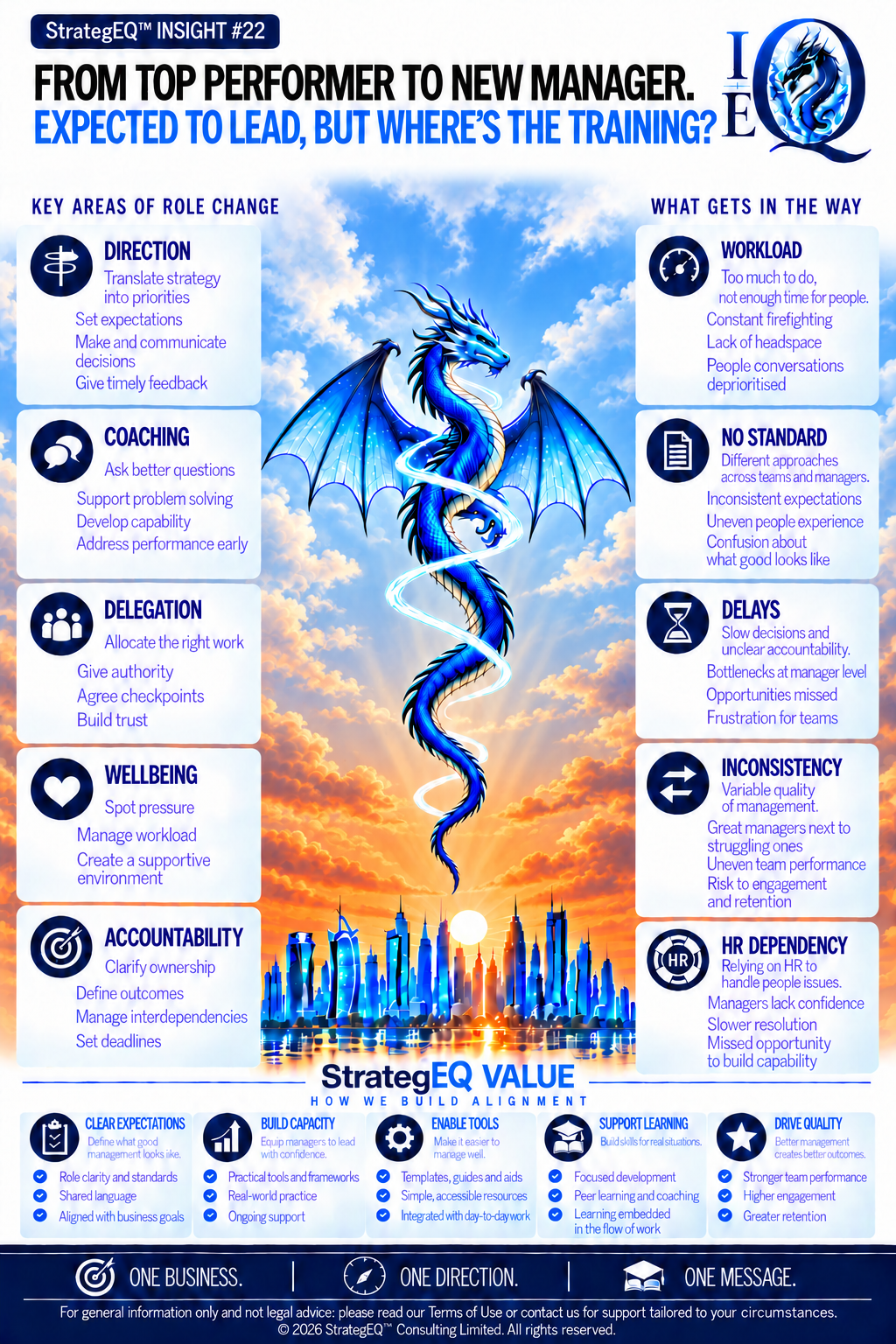
Someone who continues measuring their value through their own output may keep the difficult work, redo tasks rather than coach, answer every question and step in whenever delivery slows. The team becomes dependent on the manager instead of becoming more capable.
The transition is from delivering personally to creating the conditions in which others can deliver. That means delegating without abandoning accountability, coaching rather than automatically fixing, and providing clarity without holding every answer.
PREPARE BEFORE THE VACANCY BECOMES URGENT
Additional management capacity is often foreseeable. Funding, accelerated hiring, a major customer, expansion into another market or increasing operational complexity can all signal that more leadership will be needed.
Use that lead time. Identify potential candidates and give them controlled opportunities to lead through work the business already needs:
- Coordinate a project or cross-functional initiative.
- Run meetings and communicate priorities.
- Onboard or mentor a colleague.
- Allocate work and agree checkpoints.
- Give structured feedback.
- Deputise for an experienced manager.
Assess how they lead, not simply whether the task gets completed. Do they listen, delegate, give credit, handle disagreement and make clear decisions? Do they know when to seek support?
PREPARE FOR THE MOVE FROM PEER TO MANAGER
Relationships change alongside responsibilities. Yesterday’s peer may now allocate work, assess performance and hold information they cannot share.
Remaining approachable matters. So do confidentiality, fair treatment and the ability to hold necessary conversations with former peers. Existing friendships need judgement; they should neither create favouritism nor cause the manager to become unnecessarily distant.
CREATE CAPACITY AND PROVIDE PRACTICAL SUPPORT
Do not leave the entire previous job intact and add management on top. Under pressure, people return to familiar technical work. One-to-ones move, feedback waits and development becomes optional.
If management matters, make time for it. Keep specialist progression credible too: advancement should not depend on managing people.
Support should be proportionate to the company’s stage and operating environment. It can combine mentoring, coaching, shadowing, practical conversation guides and targeted training. Formal courses have a place, but development should address real gaps and situations rather than become a generic attendance exercise.
Managers need tools for setting expectations, delegation, feedback, difficult conversations and early action on performance or behaviour. They also need clear escalation routes. For wellbeing concerns, their role is to recognise pressure, discuss work-related support and signpost appropriate resources while maintaining professional boundaries.
People teams should build capability rather than repeatedly take over routine management responsibilities. Support and accountability must coexist.
StrategEQ VALUE
The commercial objective is stronger management capacity: clearer decisions, more capable teams, earlier conversations and less unnecessary escalation.
Measure the effect through team delivery, employee feedback, objective clarity, internal progression and the quality of decisions. Course completion alone tells you very little about whether management has improved.
Growth creates signals before it creates management vacancies. Use them. Prepare people before you need them to lead.