
Approx. 7-minute read
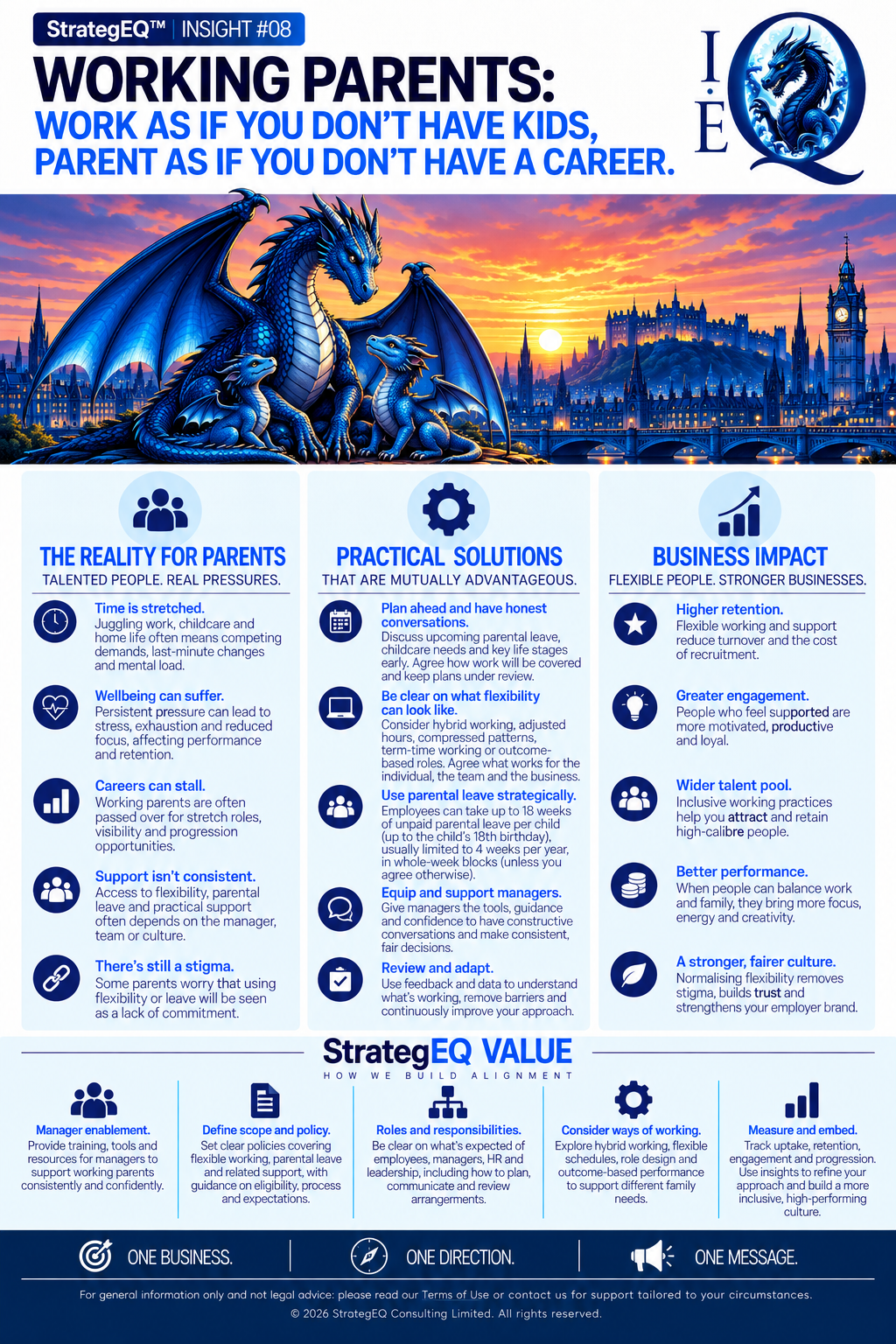
Work as if you don’t have kids, parent as if you don’t have a career.
THE COMMERCIAL POSITION
Supporting working parents is not simply an employee-benefit conversation. It is a commercial one.
Experienced employees return from family leave with knowledge, customer relationships, technical capability and company context that can be expensive to replace. When working arrangements make continued employment or progression unnecessarily difficult, the company can lose capability, continuity, management investment and future leadership talent.
Support for working parents can improve retention, widen the available talent pool, protect critical knowledge, reduce recruitment and replacement costs and support more sustainable performance. It can also strengthen trust, engagement and the employer brand.
The commercial objective is not to approve every request or remove accountability. It is to find arrangements that recognise the realities of family life while protecting delivery, customers, colleagues and performance.
The strongest solutions work for both.
PRACTICAL SOLUTIONS THAT ARE MUTUALLY ADVANTAGEOUS
Start with the work:
- Define what the role must deliver: be clear about the outputs and outcomes that matter.
- Identify when availability is genuinely required: separate real business or customer requirements from established habits about when people are expected to be visible.
- Understand location dependencies: identify which responsibilities genuinely require somebody to be in a particular place and which can be delivered differently.
- Consider the wider team: understand dependencies, handovers, coverage and the impact on colleagues.
- Protect customers and delivery: test any proposed arrangement against service, quality, deadlines and business continuity.
- Identify where there is genuine flexibility: consider where hours, working patterns, location, role design or ways of working can change without compromising performance. Then have an honest conversation.
- Plan ahead
- Discuss upcoming parental leave, childcare pressures and known family commitments early.
- Agree how work will be covered and keep arrangements under review.
- Define what flexibility can look like
- Consider hybrid working, adjusted hours, compressed patterns, part-time arrangements, job shares, temporary changes or outcome-based working where appropriate.
- Do not assume every role or employee needs the same solution.
- Set clear expectations
- Agree outputs, core availability, handovers, communication and cover.
- Flexibility should provide clarity, not ambiguity.
- Use parental leave strategically
- Understand when statutory unpaid parental leave may provide a temporary solution.
- Consider whether the company wants to provide enhanced arrangements beyond statutory minimums.
- Equip managers
- Give managers the confidence to discuss flexibility and family needs constructively.
- Make sure decisions are consistent, evidence-based and within the relevant legal framework.
- Review and adapt
- Check whether the arrangement still works for the employee, team, customers and company.
StrategEQ VALUE
The practical work sits behind the policy.
- Manager enablement
- Provide training, tools and guidance so managers can support working parents confidently and consistently.
- Define scope and policy
- Establish clear approaches to flexible working, parental leave and related support.
- Explain eligibility, process, expectations and escalation routes.
- Clarify roles and responsibilities
- Define what employees, managers, People/HR and leadership each own.
- Include planning, communication, cover, review and decision-making.
- Consider ways of working
- Review hybrid arrangements, flexible schedules, job design, part-time leadership, job sharing and outcome-based performance.
- Test whether established ways of working create unnecessary barriers.
- Measure and embed
- Track uptake, retention, engagement, performance and progression.
- Look for patterns: who requests flexibility, whose requests are accepted, who leaves after family leave and whether flexible employees continue to progress.
WHY IS THIS SUCH A PREVALENT ISSUE?
Before looking at the employee experience, it is worth recognising why this conversation is so common.
The shape of family and working life has changed. Economic need means many households depend on two incomes, while career progression, professional identity and equality of opportunity mean both parents may also want to remain economically active and continue developing their careers.
Geographic mobility has changed the support available too. Families are more likely to live away from parents, grandparents and wider family networks, so informal childcare that may once have been available locally cannot simply be assumed.
At the same time, formal childcare can be expensive, availability can be limited and nursery or school hours do not necessarily align with a normal working day.
So this is not simply a question of employees expecting employers to organise work around their personal lives. For many families, both parents working is an economic necessity as well as a career choice, while the traditional support structures that helped make that possible may no longer exist.
That context matters. It does not remove the need for employees to meet the requirements of their role, and it does not mean every flexible-working request can or should be approved. It explains why working-parent challenges are so prevalent and why practical, mutually advantageous solutions matter.
THE EMPLOYEE PERSPECTIVE
The tension is familiar: work as though you do not have children and parent as though you do not have a career.
That is not sustainable for the employee or commercially effective for the company.
Working parents manage competing responsibilities that do not conveniently happen at different times. Childcare can fail. School hours rarely mirror working hours. Children get sick. Family circumstances change. At the same time, customers still need support, teams need colleagues to deliver and companies need reliable performance.
Flexible working is one part of that picture. Employees in Great Britain have had a statutory day-one right to request flexible working since 6 April 2024. It is a right to request, not an automatic right to the arrangement requested.
Flexible working can include changes to hours, patterns or location: part-time working, compressed hours, adjusted start and finish times, hybrid arrangements, job sharing or another pattern that works for the role and company.
PARENTAL LEAVE CAN PROVIDE BREATHING SPACE
Flexible working is different from parental and other family-leave entitlements.
Unpaid Parental Leave became a day-one employment right on 6 April 2026. Eligible employees can take up to 18 weeks of unpaid parental leave for each child, up to the child’s 18th birthday. Normally, no more than four weeks per child can be taken in a year unless the employer agrees otherwise, and leave is generally taken in whole-week blocks unless an exception applies or a different arrangement is agreed.
That can provide breathing space at particular stages of family life without requiring somebody to make a permanent change to their career.
But do not collapse every family-related entitlement into one rule.
Maternity Leave, Paternity Leave, Adoption Leave, Shared Parental Leave, Unpaid Parental Leave and other family-related rights have different purposes, eligibility requirements, notice provisions and rules. Entitlement to leave and entitlement to statutory pay are also not necessarily the same thing.
For example, the April 2026 reforms made Paternity Leave and Unpaid Parental Leave available from day one, but that does not mean every associated statutory payment automatically became a day-one entitlement.
For the purposes of this Insight, the focus is on parental leave only where it is relevant to the wider flexible-working conversation and can provide temporary breathing space for working parents.
We are not attempting to cover the full family-leave framework here. A future StrategEQ Insight will look separately at the different family-leave types and their associated pay arrangements, including the important distinction between eligibility for leave and eligibility for statutory pay.
The important point here is simpler: managers need to recognise the difference between flexible working, statutory leave and pay rather than treating “parental support” as one interchangeable concept.
FLEXIBILITY IS NOT FULL-TIME CHILDCARE
Support also requires boundaries.
Working from home does not automatically mean somebody can provide full-time childcare while simultaneously performing a full-time role.
There is a difference between sensible flexibility around school runs, occasional emergencies or temporary disruption and an arrangement that requires somebody to provide sustained childcare throughout working hours while also delivering their job.
Those situations should be discussed honestly. The objective is not presenteeism. It is sustainable delivery.
CAREER PROGRESSION MATTERS TOO
A company can offer flexible working and still disadvantage working parents indirectly.
Watch what happens after flexibility is agreed. Are part-time or flexible employees still considered for stretch assignments? Can they access development? Are important meetings routinely scheduled outside their agreed hours? Is visibility being confused with contribution? Do assumptions about somebody’s family responsibilities influence decisions about promotion or travel without asking them?
Support should not quietly become a career penalty.
The same applies when employees return from family leave. Reboarding, role clarity, knowledge transfer, sensible handovers and conversations about career ambitions can make the difference between retaining experienced talent and losing it several months later.
THE COMMERCIAL PAYOFF
The employee experience and the commercial case should not be treated as competing positions.
Employees do not need every request to be approved. They do need to believe their circumstances will be considered fairly, that managers understand the options available and that using a legitimate form of flexibility or leave will not quietly damage their career.
For the company, the test is equally practical: can the arrangement maintain delivery, customer service, team effectiveness and appropriate performance standards while retaining valuable capability?
That is why this needs more than a policy. It needs clear scope, capable managers, defined responsibilities, workable ways of working and evidence about what is actually happening.
Support the individual. Protect the business. Design for both.