
Approx. 5-minute read
Company values are an operating model.
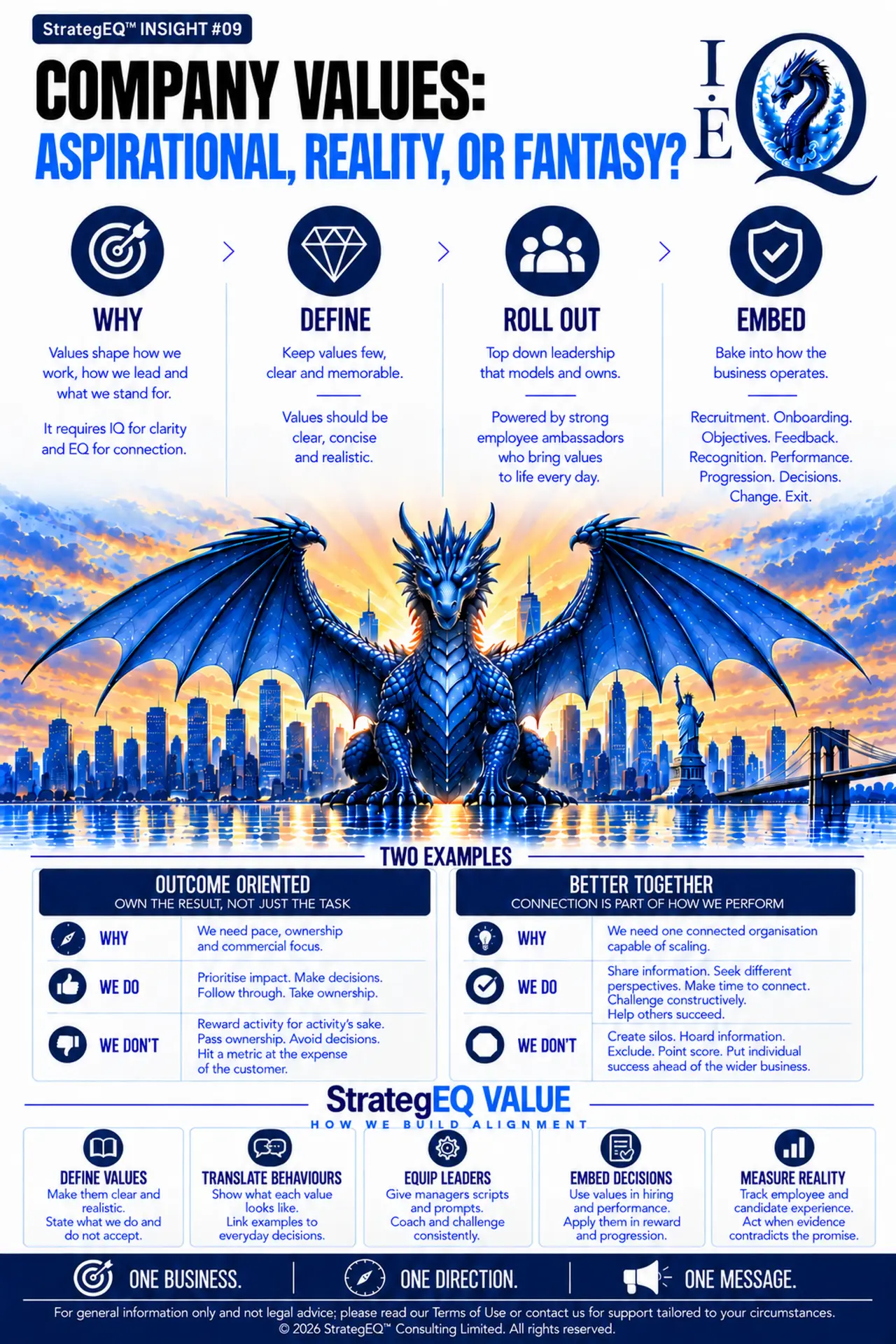
They define how you expect people to behave, how decisions should be made, what gets rewarded, what gets challenged and, ultimately, the kind of company you are trying to build.
I will say this upfront: if you are not ready to communicate them, stand by them and apply them, don't do them. It really is that simple.
Creating values because somebody thinks the company ought to have them achieves very little. Publishing a carefully chosen set of words while leadership behaves differently is worse. The values lack authenticity, leadership compromises its own credibility and employees learn very quickly that the words do not represent how the company actually operates.
At that point, they are just wall decor.
Only introduce values when you are prepared to live by them and when they genuinely reflect the workplace, team and culture you want to create.
That does not mean everybody needs to behave identically. Nor should values become a mechanism for hiring people who look, think or behave like the existing team. They should establish a small number of meaningful behavioural principles that help people understand how work gets done here.
THE BUSINESS CASE
Properly implemented, values have commercial value.
As a company grows, founders become progressively further removed from everyday decisions and interactions. Values can provide part of the framework that replaces that proximity. They can help:
- make better hiring and promotion decisions;
- establish clear behavioural expectations;
- give managers a framework for feedback and performance;
- guide decisions where no policy exists;
- reinforce accountability;
- recognise and reward the behaviours the company needs; and
- maintain alignment as teams, locations and management layers expand.
There is a commercial risk in getting them wrong too. A company that publicly talks about collaboration but rewards individual behaviour at the expense of the team creates cynicism. A company that says it values challenge but penalises people for disagreeing with senior leaders teaches employees very quickly that the published value is not the real one.
Employees will believe what the company does, not what the poster says.
The real test is not whether the values sound good. It is whether the company is prepared to make decisions because of them.
If you say Challenge matters, what happens when somebody respectfully challenges the CEO?
If you say Collaboration matters, what happens when your highest performer consistently delivers results at everybody else's expense?
If you say Ownership matters, do leaders acknowledge their own mistakes as openly as they expect employees to?
Those moments establish the real values of the company far more effectively than anything written on a wall.
KEEP THE MODEL SIMPLE
A simple framework makes values easier to understand and use:
VALUE → WE DO → WE DO NOT
If the value is OWNERSHIP:
WE DO:
- take responsibility for outcomes;
- raise problems early;
- follow through on commitments; and
- ask for help before something becomes a bigger issue.
WE DO NOT:
- wait for somebody else to solve the problem;
- hide mistakes;
- blame other teams; or
- repeatedly miss commitments without communicating.
If the value is CHALLENGE:
WE DO:
- question assumptions respectfully;
- bring evidence and alternative ideas;
- speak up when something does not make sense; and
- support the agreed decision once it has been made.
WE DO NOT:
- confuse challenge with aggression;
- undermine decisions afterwards;
- stay silent in the meeting and complain outside it; or
- treat seniority as protection from challenge.
Now the value means something. People can recognise the behaviour, managers can reinforce it and the company can use it when making decisions.
CHOOSE VALUES THAT ACTUALLY MEAN SOMETHING
Words such as integrity, excellence, teamwork and innovation may all be positive, but on their own they tell employees very little about how your company expects them to behave.
Ask:
- Why does this value matter to our business?
- What would I see somebody doing if they were living it?
- What behaviour would clearly contradict it?
- Would this help a manager make a difficult decision?
- Could a candidate understand something meaningful about how we operate from it?
- Is this genuinely how we want to work, or simply how we would like to describe ourselves?
Values should be distinctive enough to help explain how your company operates without becoming slogans nobody can translate into action.
MAKE BEHAVIOUR OBSERVABLE
Abstract values become useful when translated into observable behaviour.
That does not mean creating an enormous competency framework. It means giving enough practical context that people understand what the value looks like in real work.
For each value, define:
- what we do;
- what we do not do;
- examples relevant to everyday work;
- what managers should reinforce; and
- what behaviour should be challenged.
The objective is clarity, not bureaucracy.
BUILD VALUES INTO THE EMPLOYEE LIFECYCLE
Values become real when they influence decisions.
Use them appropriately across:
- recruitment and candidate assessment;
- onboarding;
- objectives and expectations;
- one-to-ones and feedback;
- recognition;
- development;
- promotion;
- performance conversations; and
- leadership decisions.
That does not mean assessing somebody on whether they have the same personality or background as the existing team. Values should describe relevant behaviours, not become a proxy for subjective “culture fit”.
The question should be whether somebody can operate successfully within the behaviours the company genuinely requires.
LEADERSHIP HAS TO LIVE THEM
Leadership behaviour will outweigh written values every time.
If leaders say one thing and reward another, employees notice. If somebody consistently delivers strong commercial results while behaving in a way that contradicts the company's stated values and nothing happens, that behaviour becomes part of the real culture.
What gets promoted matters. What gets rewarded matters. What gets challenged matters. And what gets tolerated matters.
Values cannot apply only when convenient or only to employees below a certain level of seniority. Leaders and high performers need to be held to the same behavioural expectations if the values are going to retain credibility.
REVIEW AS YOU SCALE
The underlying values may remain stable, but what they require in practice can change as the company grows.
A value such as ownership may look different when everyone sits in one room from when teams operate across countries and time zones. Collaboration changes as functions specialise. Communication becomes more deliberate as informal founder access reduces.
Periodically ask:
- Are these still the right values?
- Do the behavioural examples still reflect how we need to operate?
- Are managers actually using them?
- Do employees recognise them in leadership behaviour?
- Are our hiring, recognition and promotion decisions consistent with them?
- Where does the reality contradict what we say?
The answer may not require changing the values. It may require changing the behaviour.
THE COMMERCIAL TEST
Values should make decisions easier, expectations clearer and behaviour more predictable as the company scales.
If they cannot help somebody understand what good looks like, challenge behaviour that does not fit or make a better people decision, they are probably not doing enough work.
The principle is straightforward: only create values if you are prepared to live by them. Communicate them, make the behaviours observable, apply them consistently and be prepared to stand by them when doing so is inconvenient.
Otherwise, don't do them.
Values are not wall decor. They are a practical description of how your company expects people to operate.