
Approx. 5-minute read
Your employer brand got their attention. Can your recruitment process convert it?
An open role is not simply a recruitment challenge.
It is missing business capacity.
If the capability is commercially important, every week the seat remains empty can affect what the organisation can sell, deliver and recognise as revenue.
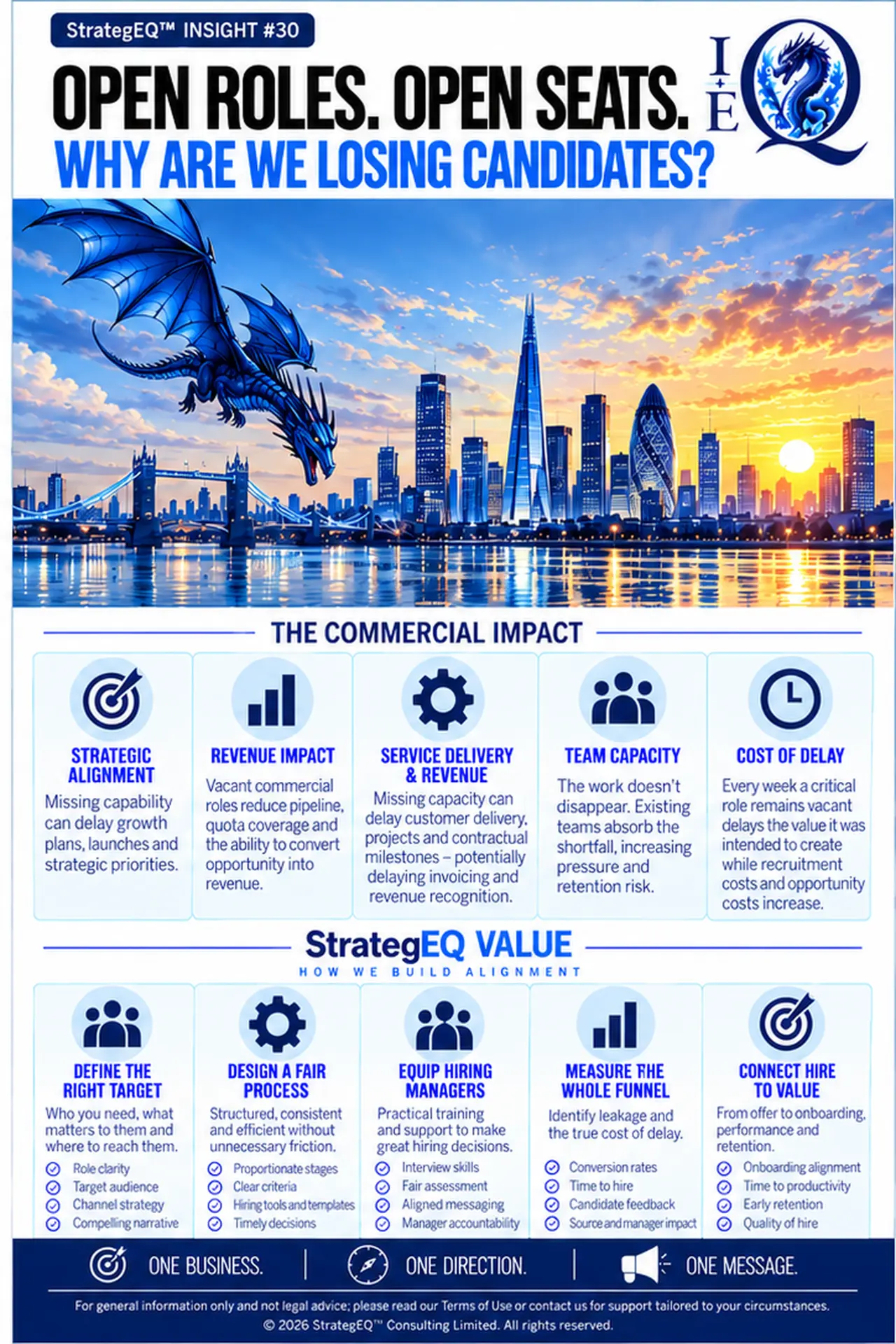
THE COMMERCIAL IMPACT
- Strategic alignment — missing critical capability can delay growth plans, launches, transformation and strategic priorities.
- Revenue impact — vacant commercial roles reduce pipeline capacity, quota coverage and the organisation’s ability to convert opportunity into revenue.
- Service delivery & revenue — insufficient delivery capacity can delay customer commitments, projects and contractual milestones, potentially delaying invoicing and revenue recognition.
- Team capacity — the work does not disappear because the seat is empty. Existing teams absorb the shortfall, increasing pressure, reducing capacity elsewhere and creating retention risk.
- Cost of delay — every week a critical role remains vacant delays the value it was intended to create while recruitment costs, management time and opportunity costs continue.
So before increasing time and spend at the top of the funnel, understand what is happening throughout it.
KNOW WHO YOU ARE TRYING TO TALK TO
Recruitment starts before somebody applies.
Start with the role — not organisation design, which is a separate conversation — but with the proposition you are taking to the talent market.
Who are you actually trying to attract?
Not simply a job title and five years’ experience.
Get into their mind. What are they doing today? What would make them move? What matters to them? What would make them stop scrolling, reply to an approach or give you 30 minutes to discuss an organisation they may barely know?
Then communicate accordingly.
A generic job description dropped onto LinkedIn?
Meh.
It might generate applications. That does not mean it is reaching the people you actually want.
Strong candidates may not be looking. Outbound communication needs to give them a reason to engage rather than sounding like another message sent to 200 people with the same job title.
CANDIDATES ARE ASSESSING YOU TOO
Strong candidates have choices.
I spoke recently with two co-founders who could not consistently articulate their own value proposition — what the business actually did, the challenge it solved or why a customer would choose them.
Behind closed doors, it was awkward.
Put that into an interview and it becomes a huge warning sign.
Candidates notice when interviewers describe the company differently, when nobody can explain what success looks like or when answers about strategy, priorities and reporting lines conflict.
If leadership cannot clearly explain what the business does, where it is going and why this role matters, candidates may reasonably wonder what else inside the organisation is unclear.
Recruitment is therefore an organisational credibility test as much as a candidate assessment.
FIND THE LEAKAGE BEFORE BUYING MORE CANDIDATES
Follow the data through the recruitment journey:
- Reach → engagement — are the people you target responding?
- Advert → application — are the right people applying, not simply lots of people?
- Application → interview — is attraction generating relevant talent?
- Interview → progression — where are good candidates being rejected or withdrawing?
- Offer → acceptance — are offers competitive and consistent with what was previously communicated?
- Acceptance → start — are candidates remaining engaged through notice periods and counteroffers?
“We need more candidates” creates one response.
“We attract strong candidates but lose 35% after second interview” creates another.
One increases activity. The other identifies something you can fix.
RIGOUR WITHOUT FRICTION
Candidate experience does not mean lowering the assessment bar.
Senior, technical or high-risk appointments may legitimately require several interviews, assessments or detailed scrutiny. But every stage should earn its place.
If you need five interviews, what does each one assess? If you use an assessment, what evidence does it provide? If another executive needs to meet the candidate, are they evaluating something new or simply repeating the previous conversation?
Rigour adds value. Duplication does not.
Clear ownership matters too. Candidates experience the cumulative delay created by Talent, hiring managers, Finance and leadership. They do not care which internal function caused it.
RECRUITMENT DOESN’T END ON DAY ONE
An accepted offer is a conversion point, not the outcome.
Someone arriving on day one proves that you converted a candidate into an employee. It does not prove that you made a successful hire.
That becomes clearer during onboarding and probation, when the proposition sold during recruitment meets organisational reality.
Continue measuring:
- onboarding effectiveness and expectation alignment;
- time to productivity;
- probation outcomes;
- early attrition;
- quality of hire.
Then send that information backwards.
If people leave because the role was not what they expected, revisit the proposition. If new hires repeatedly lack the same capability, revisit selection. If good hires consistently struggle under one manager, examine the management environment.
The real recruitment journey is:
Target → Reach → Engage → Apply → Assess → Offer → Accept → Join → Onboard → Perform → Retain.
THE COMMERCIAL UPSIDE
Getting this right does not simply create a better candidate experience.
It can reduce vacancy time, decrease wasted sourcing expenditure, improve hiring decisions, increase offer conversion, accelerate time to productivity and reduce early attrition.
Most importantly, it increases the probability that the investment made in recruitment turns into the capability the business actually needed.
StrategEQ VALUE — HOW WE BUILD ALIGNMENT
StrategEQ helps organisations connect recruitment directly to business outcomes rather than treating it as a transactional HR process.
- Define the right target — identify the capability required, who has it and what will make them engage.
- Design a fair process — create rigorous, proportionate assessment without unnecessary friction.
- Equip hiring managers — strengthen interviewing, consistency, decision-making and candidate communication.
- Measure the whole funnel — identify leakage, conversion and the true commercial cost of delay.
- Connect hire to value — extend measurement through onboarding, probation, productivity, retention and quality of hire.
The objective is not to fill a vacancy.
It is to secure the capability the business needs and convert that investment into performance.
Recruitment starts before the application. Its success is measured months after day one.