
Approx. 5-minute read
Startup companies need enough structure, policy and process to demonstrate compliance with local legislation and employment law, while retaining the agility to pivot as the company, its priorities and its operating model change.
The commercial challenge is getting the timing right. Build too little and risk accumulates, decisions remain dependent on individuals and the company eventually has to retrofit foundations while trying to scale. Build too much, too early, and you invest money, management time and leadership capacity in infrastructure the business does not yet need.
Being lean should not mean being surprised by something you could reasonably have anticipated. Funding plans, commercial pipeline, customer growth, international expansion, regulatory requirements, cost pressures and planned headcount all provide signals about what may be needed next.
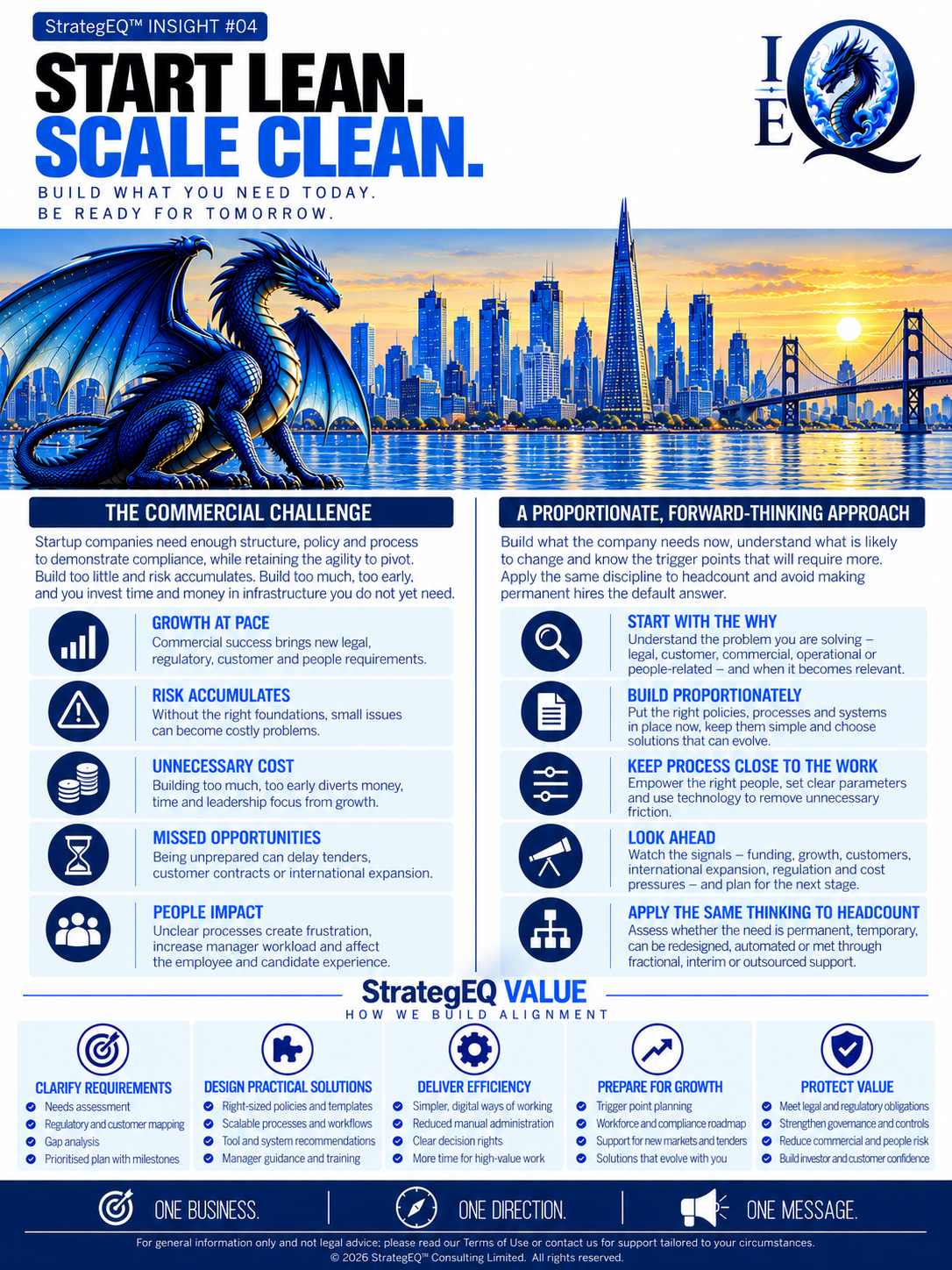
The principle behind Start Lean. Scale Clean. is therefore simple: build what the company needs now, understand what is likely to change and know the trigger points that will require something more.
START WITH THE QUESTION: WHAT PROBLEM ARE WE SOLVING?
Before introducing another policy or process, understand why it needs to exist. Is it:
- a legal or regulatory requirement?
- required by your industry or regulatory environment?
- a customer, contractual or tender requirement?
- managing a genuine business or People risk?
- removing repetitive administration?
- enabling managers to make decisions without everything escalating upwards?
- improving the employee or candidate experience?
- providing information needed to make better decisions?
- preparing for something the company can reasonably see coming?
Not every People requirement originates in employment legislation. Sometimes a control becomes commercially necessary because of where the company operates, who it sells to or where it wants to sell next.
A customer, tender or operating environment might require:
- background screening, including criminal-record checks where appropriate and lawful;
- BPSS or security clearance for government, defence or restricted environments;
- regulatory references, screening or fitness and propriety requirements within financial services;
- justified credit or financial-integrity checks;
- customer-mandated training or certification;
- information-security, confidentiality or security-awareness controls;
- health surveillance or occupational requirements for particular environments; or
- evidence of modern-slavery, equality, whistleblowing, anti-bribery or data-protection controls during procurement or due diligence.
Commercial pipeline should therefore inform People planning. If the company intends to tender for a major financial-services client, enter government procurement or move into a security-sensitive environment, understand what will be required before the opportunity arrives. Equally, do not build an entire compliance framework today for a hypothetical opportunity several years away.
Understand the requirement, understand when it becomes relevant and build proportionately ahead of the trigger. If you cannot explain the purpose of a policy or process, question whether you need it yet. Policies and procedures for the sake of it are overhead, not infrastructure.
BUILD PROPORTIONATELY
Being lean is not an excuse for ignoring the fundamentals. Employment documentation, required policies, Right to Work, payroll, pensions, statutory entitlements, health and safety and appropriate data controls need to be in place when they apply.
Beyond those foundations, ask:
- What do we genuinely need now?
- What risk or requirement does it address?
- Is the solution proportionate?
- What will it cost in money and management time?
- Could a simpler solution achieve the same outcome?
- Can what we build evolve rather than needing complete replacement?
- What future event would trigger the need for something more?
A 20-person startup does not need the policy library, approval hierarchy, performance infrastructure or People systems of a 2,000-person company. A short policy that people understand and use can be considerably more effective than a 40-page document nobody reads. More documentation does not automatically mean better governance.
KEEP PROCESS CLOSE TO THE WORK
Every approval, hand-off and workflow creates friction. Some decisions appropriately require oversight, particularly where there is material financial, legal or employee-relations risk. Routine decisions should not automatically require the same treatment.
When designing a process, consider:
- who has the information and capability to make the decision;
- the consequence if they get it wrong;
- what genuinely requires escalation;
- whether clear parameters would allow the decision to be delegated; and
- whether technology could remove administration without removing accountability.
The objective is controlled delegation. Founders and senior leaders retain visibility of material decisions without becoming the approval point for routine activity that somebody else is capable of managing. That protects leadership capacity as the business grows.
KEEP ONE EYE ON WHAT IS COMING NEXT
You do not need enterprise infrastructure on day one, but you should understand what could cause today's solution to stop working.
Watch the signals:
- funding and investor requirements;
- commercial pipeline and customer growth;
- planned headcount;
- new management layers;
- international expansion;
- regulatory exposure;
- recruitment volume;
- employee-relations complexity;
- cost pressures; and
- reporting or system requirements.
Sometimes a spreadsheet is exactly the right answer. Sometimes a modest investment today avoids replacing a solution six months later. The objective is not to buy for scale at any cost, but to avoid predictable rework.
The warning signs are often practical. If founders are repeatedly making routine People decisions, managers are inventing their own processes, employee data is spread across multiple spreadsheets or the same issues repeatedly escalate upwards, the company may have outgrown the original solution. That does not automatically mean adding bureaucracy. It means considering whether the next layer of structure has now earned its place.
APPLY THE SAME DISCIPLINE TO HEADCOUNT
The same principles apply to workforce growth. Organisation design deserves a separate discussion, and we will return to it in a future insight, but permanent headcount should not automatically be the answer every time more capacity is needed.
Before adding another permanent role, ask:
- Is the requirement permanent or a temporary spike in workload?
- Is additional headcount required, or could the work itself be redesigned?
- Could technology automate or remove part of the requirement?
- Could priorities or responsibilities be redistributed?
- Would fractional, interim, consultancy or outsourced support be more proportionate?
- Do we need the capability permanently, but not yet at full-time scale?
- What is the fully loaded cost of permanent headcount compared with the alternatives?
- Are we solving a short-term problem with a long-term fixed cost?
Permanent hiring may be exactly the right answer. The commercial discipline is making it a considered answer rather than the default one.
The same test therefore applies to policy, process, systems and people: understand the requirement, consider the alternatives, assess proportionality and cost, and maintain enough visibility of what is coming next to act before the business becomes constrained.
Start lean does not mean under-building the foundations. Scale clean does not mean waiting for something to break. It means investing at the point the business needs it, without spending today's time and money solving tomorrow's hypothetical problems or tomorrow's time and money fixing yesterday's predictable ones.
Build what you need today, with one eye on what you will need tomorrow.