Approx. 5-minute read
I want to make something clear upfront. This is not a regulatory or governance piece about the use of AI.
That subject is far too complex and nuanced to reduce to a few paragraphs. UK GDPR, data protection, automated decision-making and, where relevant, the EU AI Act all require proper consideration.
For the purposes of this piece, I am looking at something different: AI as it relates to people and process.
Technology in recruitment is not new. People teams have been using HRIS platforms, applicant tracking systems, assessment tools and automated workflows for decades. We already use technology to store information, standardise processes, automate administration and manage recruitment at scale.
What is new is the additional layer AI provides.
AI can process huge volumes of information, summarise applications, identify patterns, support sourcing, generate communications and map a CV and application responses against a posted role in seconds.
And it works both ways. Candidates can use the same technology to analyse a job description, tailor their CV and application responses, prepare for interviews and position their experience against the requirements of the role.
Which takes us towards the emerging absurdity of fully automated recruitment:
Bot applies to bot.
Potentially very efficient. But what exactly have we learnt about the person?
What are you actually hiring?
A CV tells us what somebody has done. An application gives us more information about how they present that experience. Neither necessarily tells us what somebody could become.
Potential, motivation, personality, priorities, curiosity, judgement, resilience, self-awareness and interpersonal capability are much harder to quantify. So is whether somebody can build trust, influence other people, read a room, challenge appropriately or think on their feet when the conversation does not follow a prepared script.
Depending on the role, those things can be the difference between somebody who meets the specification and somebody who genuinely succeeds.
Two candidates can have remarkably similar CVs and perform completely differently in the same job. Someone with less direct experience may outperform a technically stronger candidate because they learn faster, communicate better, build stronger relationships or simply want it more.
The unconventional candidate matters here too. Their experience may sit in another sector. Their career may have taken an unusual route. They may have taken time out, changed direction or developed relevant capability somewhere an automated matching process does not immediately recognise.
Potential is particularly difficult to derive from historical data because, by definition, it is partly about what somebody has not done yet.
If recruitment increasingly rewards the closest historical match to a job description, companies risk becoming exceptionally efficient at hiring more of what they already have. That may not be what the business needs next.
Match the assessment to the role
Not every job requires the same balance between technical evidence and human interaction.
For some roles, capability can be tested relatively objectively. For others, interpersonal skills are fundamental to performance.
A salesperson needs to establish trust and influence. A manager needs to communicate, listen and adapt. A consultant needs to understand a client, challenge appropriately and build credibility.
Those capabilities need to be experienced, not simply inferred from an application.
That is also why face-to-face interaction still has a legitimate place in recruitment. Meeting somebody in person allows you to observe how they communicate without the same opportunity to rely on prepared or AI-generated prompts: how they think on the spot, respond under pressure, react to an unexpected or challenging question, listen, adapt and develop an idea in real time.
It is not about judging whether somebody simply “feels right”. That risks replacing structured assessment with subjective preference and introducing bias. The value is in seeing relevant behaviours and interpersonal capability directly, particularly where those capabilities matter to performance in the role.
Used alongside structured questions and objective assessment criteria, an in-person conversation can provide a more authentic view of how somebody operates when the answer has not been polished in advance. Applications, written responses and remote assessments can increasingly be supported by offline materials or AI. Live interaction gives the interviewer the opportunity to probe, follow up, challenge an answer and see how the candidate responds when the conversation moves somewhere they could not completely prepare for.
Human judgement has limitations too, so face-to-face assessment should complement evidence rather than replace it. Use evidence to test capability, technology to organise and consolidate it, and meaningful human interaction to understand the person behind it.
Where does AI add value?
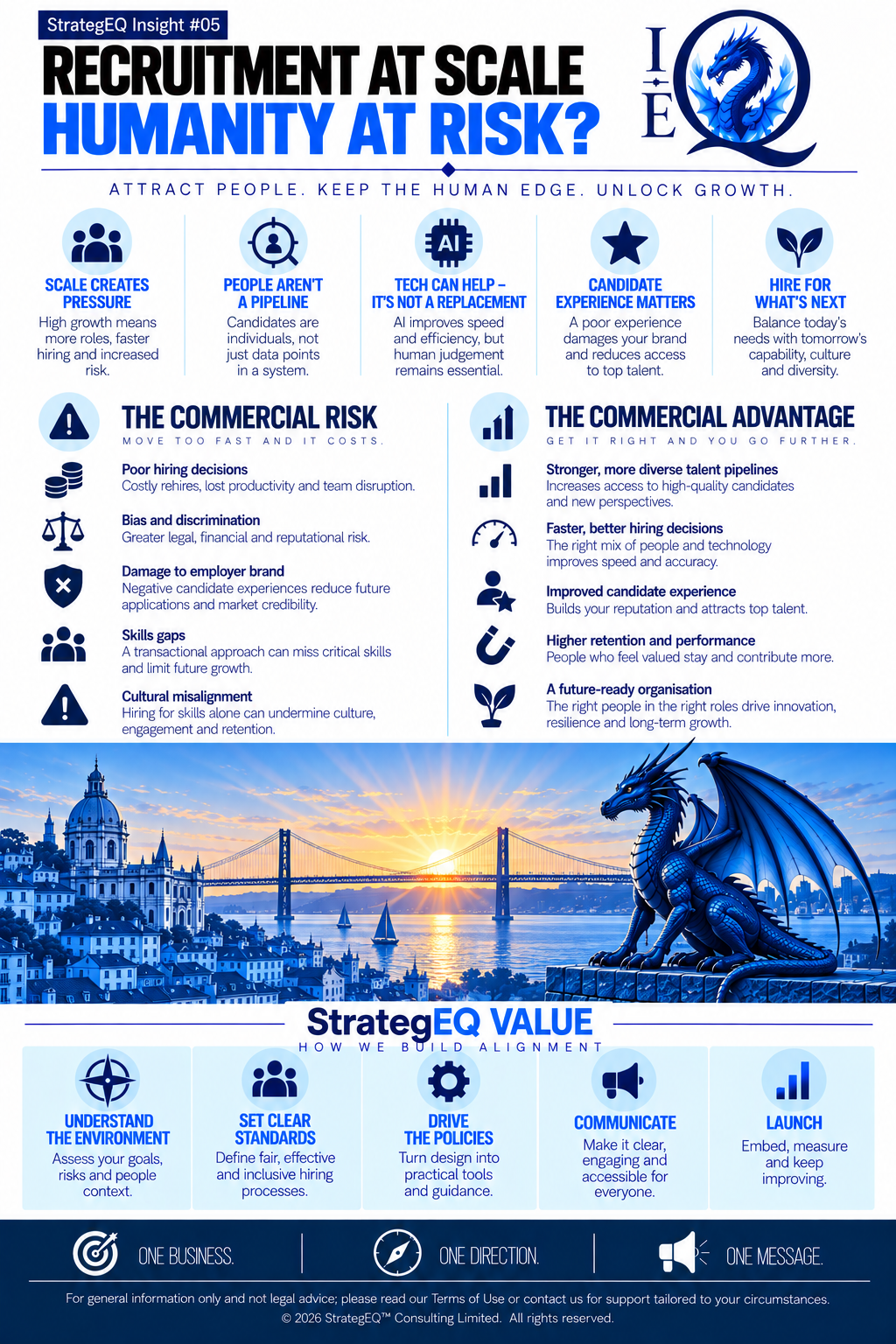
Recruitment at scale creates significant repetitive activity. Used well, AI can:
- automate administrative and repetitive tasks;
- organise and consolidate large volumes of candidate information;
- support sourcing and initial screening;
- map CVs and application responses against the requirements of a posted role;
- identify apparent matches, gaps and relevant experience;
- support scheduling and candidate communications;
- help standardise appropriate elements of assessment; and
- give recruiters and hiring managers more time to focus on higher-value activity.
AI can also turn recruitment activity into useful management information. Properly connected across the ATS, HRIS and relevant performance data, it can help identify patterns that are difficult to see when recruitment information sits in isolation.
That could include:
- tracking time-to-fill and time-to-hire, including where delays occur;
- measuring hiring-manager response and feedback times, exposing bottlenecks rather than assuming recruitment is the problem;
- analysing candidate conversion, withdrawal and offer-acceptance patterns;
- comparing sourcing channels against successful hires rather than simply application volume;
- connecting recruitment data with HRIS and performance information to understand quality of hire;
- tracking early attrition, retention and time-to-productivity; and
- identifying patterns across roles, teams and hiring managers that can improve future recruitment decisions.
This is where connected data becomes particularly valuable. Filling a vacancy quickly tells you very little if the person leaves four months later. A recruitment process should ultimately be measured against the quality and longevity of the people it brings into the company, not simply how efficiently it moves candidates through a funnel.
Used properly, AI can help connect those dots. It can show not only how quickly you hired, but where the process slowed down, what produced the strongest hires and what happened to those people after they joined.
That makes the commercial opportunity much broader than simply processing more candidates with fewer people.
Start with the problem
AI cannot fix a badly designed recruitment process.
If hiring is slow because managers take a week to provide feedback, AI is not the underlying solution. If candidates withdraw because the salary or role is unclear, automation will not fix the proposition. If quality-of-hire is poor because nobody properly defined what success looks like, AI may simply identify more candidates against the wrong criteria.
Start with the problem, then decide where technology genuinely adds value.
There still needs to be governance. If AI materially influences people’s employment opportunities, companies need to understand how it is being used, retain meaningful human accountability and consider the relevant data-protection and AI frameworks.
But compliance is the baseline, not the commercial opportunity.
The opportunity is to let technology do what technology does well while creating more space for the things people do better.
AI can make recruitment faster, more consistent and easier to scale. The objective should not be removing people from recruitment. It should be removing unnecessary work so people can spend more time on the parts where being human actually matters.
Automate the process. Not the relationship.
Otherwise, we risk building an extraordinarily efficient recruitment system while forgetting to meet the person we are actually thinking about hiring.