Approx. 6-minute read
START WITH WHY: AGILITY IS COMMERCIAL
Startups operate in environments where assumptions are tested constantly. Customer behaviour changes, markets move, technology develops, funding alters what is possible and commercial priorities shift as better information becomes available.
The ability to respond quickly is not simply part of startup culture. It is a commercial capability.
Companies need to be able to stop investing in something that is not working, redirect resources towards an emerging opportunity, change a product in response to customers or restructure when the operating model no longer supports growth.
That agility can create competitive advantage. It also means that the company people join today may look very different in twelve months.
Systems will change. Processes will mature. Teams will grow, divide or restructure. Roles and reporting lines will evolve. New capabilities will be introduced and some priorities will disappear altogether.
For the right people, that environment can be addictive: fast, ambitious, challenging and exhilarating.
But people need to know that this is part of the deal.
SET THE EXPECTATION FROM THE BEGINNING
Startups are good at selling the opportunity: autonomy, pace, impact, growth and the chance to build something.
They need to be equally clear about the uncertainty.
Hiring for a startup is not only about whether somebody can perform today’s role. It is also about whether they can continue contributing as the company around them changes.
That expectation should begin during recruitment and continue through onboarding and management:
- Roles will evolve. A job description reflects what the company needs now, not necessarily what it will need forever.
- Priorities will change. New commercial information should influence where time and money are invested.
- Structure will mature. Growth can require clearer accountability, specialist roles and additional management capability.
- Systems and processes will develop. Informal ways of working eventually stop scaling.
- People will need to keep learning. Capability has to evolve alongside the company.
This is not about lowering expectations of the employee experience. It is about creating an accurate one.
AGILITY IS NOT CHAOS
There is an important distinction between a company that responds quickly and one that simply operates unpredictably.
“It’s a startup” should never become an excuse for weak management.
Repeatedly changing priorities without explanation, unclear accountability, duplicated work, poor decision-making and expecting employees to compensate indefinitely for inadequate systems all carry commercial cost.
Equally, the answer is not bureaucracy.
The objective is proportionate infrastructure: enough structure to enable the next stage of growth without removing the speed and entrepreneurialism that created the opportunity in the first place.
A process should exist because it solves a problem, manages a risk, improves consistency or enables scale. Not simply because larger companies have one.
THE PEOPLE IMPACT BECOMES A BUSINESS IMPACT
Change creates uncertainty because people naturally want to understand what it means for them.
Why has the priority changed? Is my role affected? Why are we recruiting into one team rather than another? Why has a reporting line moved? Why are we replacing a system we only recently introduced?
Without sufficient context, people fill the gaps themselves.
That can quickly become commercially relevant through:
- management time consumed by speculation and repeated questions;
- slower decisions because people are unsure of priorities or authority;
- resistance to new systems, structures or ways of working;
- duplicated or abandoned work when direction is unclear;
- reduced productivity while teams try to interpret what is happening;
- unwanted attrition when uncertainty becomes instability.
The objective is not to make people comfortable with every decision. It is to build sufficient trust, clarity and adaptability that the company can continue executing while things change.
COMMUNICATE WHAT YOU CAN
Good communication is central to that trust, but transparency does not mean everybody knowing everything.
There will be legitimate reasons why information cannot, should not or cannot yet be shared.
Funding discussions may be confidential. Acquisitions can be commercially sensitive. Employee matters are private. Customer negotiations may be restricted. Legal advice may be privileged. Potential restructures may still be under consideration. Boards, investors and contractual obligations can impose confidentiality.
Trying to promise complete transparency creates an expectation leadership cannot fulfil.
A more credible framework is:
We will tell you what we can, when we can. When we cannot share something, we will be honest about that too.
That means communicating with authenticity rather than attempting to eliminate uncertainty.
Explain what has changed and why where possible. Distinguish decisions from possibilities. Say when something has not yet been decided. Acknowledge when information cannot be shared rather than creating a vague or artificial explanation.
People do not need access to every piece of information to trust leadership.
They need confidence that the information they are given is credible.
GIVE PEOPLE A FRAMEWORK FOR CHANGE
Change becomes easier to navigate when employees and managers understand how the company approaches it.
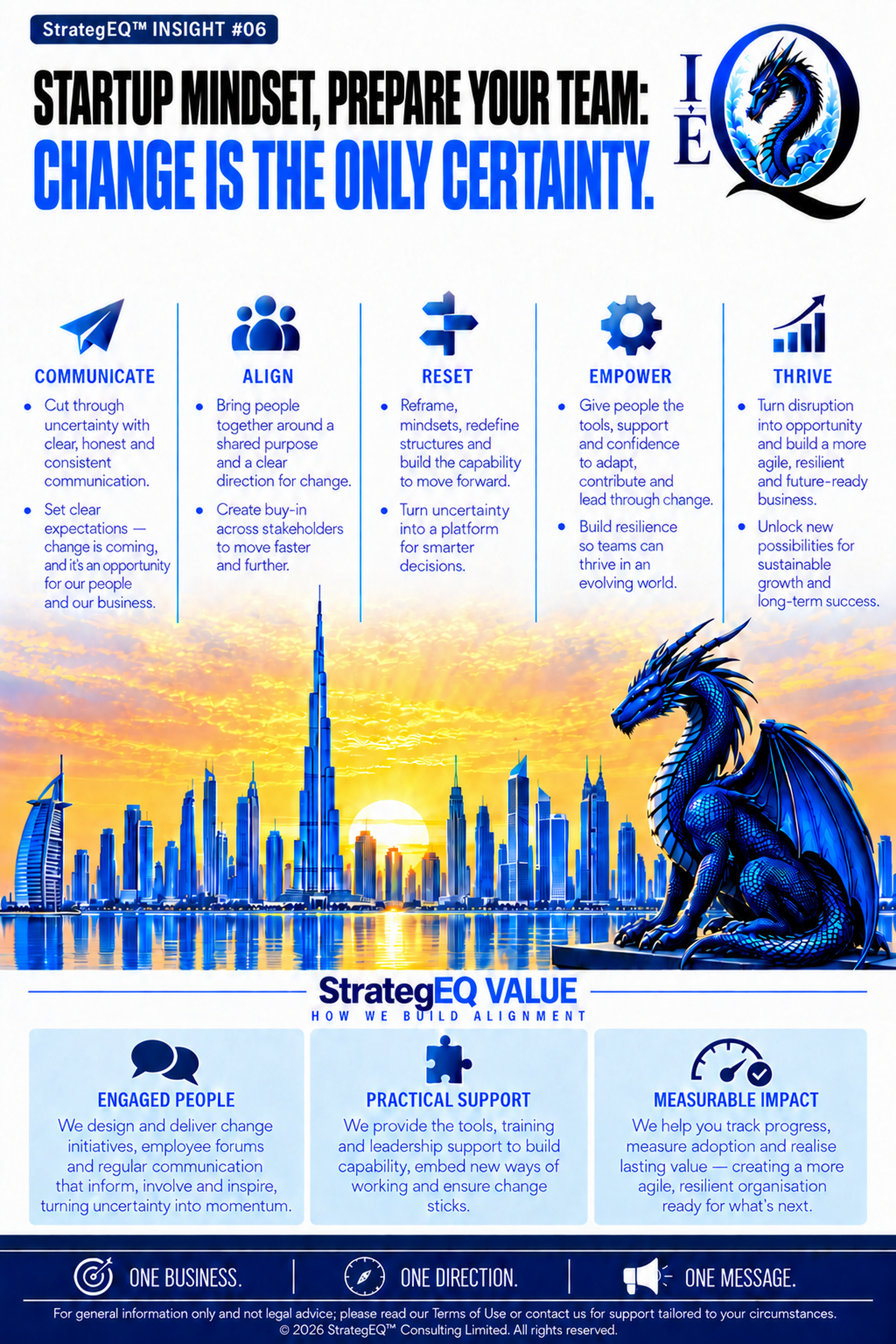
Communicate Provide clear, consistent context. Explain what is changing, what it means and what people need to do differently.
Align Connect change to the commercial objective. People should understand what the business is trying to achieve rather than experiencing a series of apparently disconnected initiatives.
Reset Be willing to change priorities, responsibilities and ways of working when the evidence changes. Avoid protecting yesterday’s decision simply because time or money has already been invested in it.
Empower Give managers the context, tools and authority to lead their teams through uncertainty. Senior leadership should not need to become the communication channel for every change.
Thrive Build adaptability as a capability so that each period of change strengthens rather than exhausts the company.
PROTECT THE ANCHORS
A company can change rapidly without making everything feel temporary.
Some things should provide greater continuity: the company’s purpose, strategic direction, values, behavioural expectations and standards of performance.
These become anchors when the operating environment moves.
People can understand that how we get there may change without assuming that everything is up for negotiation.
That balance matters. Too much rigidity can prevent a startup responding to opportunity. Too little consistency makes agility feel like instability.
STRATEGIC VALUE: HOW WE BUILD ALIGNMENT
StrategEQ supports the people side of change, helping companies translate commercial movement into an environment in which employees and managers can continue to perform.
Engaged People Employee communication, listening channels, forums and feedback mechanisms that help people understand change, contribute appropriately and surface barriers early.
Equipped Managers Practical manager briefings, conversation frameworks, training and change support that enable managers to translate company decisions into clear direction for their teams.
Change-Ready Teams Onboarding, change education, employee involvement and targeted support that build adaptability and help people operate effectively as roles, structures and ways of working evolve.
The commercial decisions belong to the business. StrategEQ helps build the people capability required to execute them.
CHANGE IS PART OF THE PROPOSITION
Startup life can be exhilarating precisely because it moves quickly. The objective should not be to remove that energy by trying to make an early-stage company behave like a mature corporate.
It is to create enough clarity, trust and infrastructure for the business to keep moving at speed as it grows.
Set that expectation before people join. Reinforce it through onboarding. Equip managers to lead through uncertainty. Communicate what can be communicated and be credible about what cannot.
Then change stops being an occasional programme that disrupts the business.
It becomes a capability that helps the business grow.