Approx. 6-minute read
Performance management should improve performance. It sounds obvious, but too often the process becomes the objective.
A company introduces OKRs because it is scaling. It launches 360 feedback because it wants better leadership. It builds a nine-box because it needs succession planning. Or it continues with annual appraisals because that is simply what it has always done.
The methodology should never be the starting point.
The starting point is: what are we trying to achieve?
THE COMMERCIAL CASE
Performance management should create value for the business. If it consumes significant management time, generates administration and produces little change in behaviour or output, something has gone wrong.
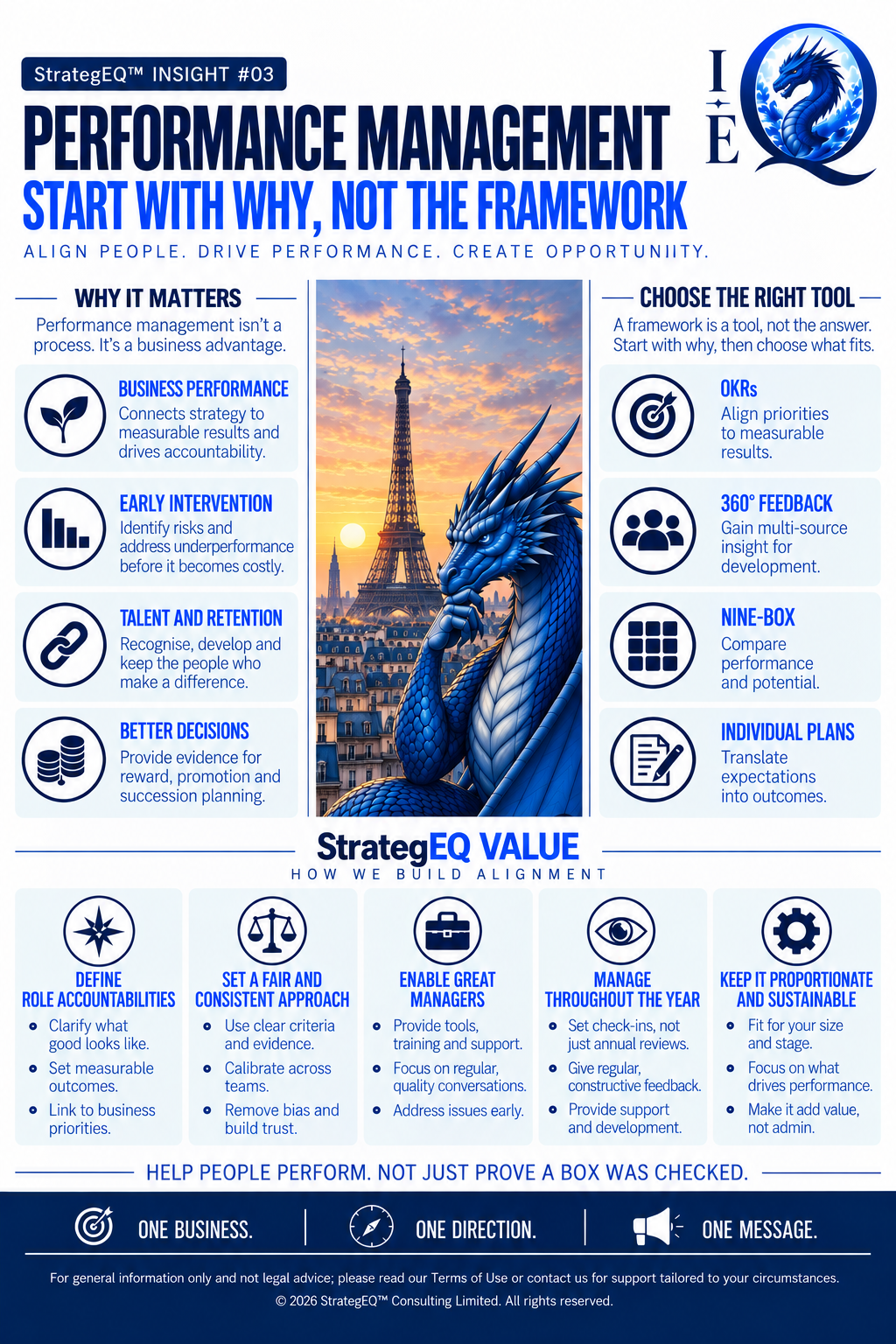
A purposeful approach creates alignment between business priorities, team objectives and individual contribution. It helps a company understand what is working, where capability is strong and where intervention is required.
Commercially, that can mean:
- clearer accountability for delivery and results;
- stronger alignment between individual activity and company priorities;
- earlier identification of underperformance before it becomes expensive;
- better evidence for reward, promotion and talent decisions;
- greater visibility of capability gaps and succession risk;
- stronger retention of people the company wants to keep;
- better development and deployment of existing talent; and
- less management time spent resolving performance issues that have been allowed to drift.
This is why performance management needs to be both proactive and reactive.
Proactively, it should help people understand what good performance looks like and enable them to deliver it.
Reactively, it should give managers a fair, evidence-based way of intervening when expectations are not being met.
The commercial objective is not more performance management. It is better performance.
WHAT DOES THE BUSINESS GET FROM IT?
At company level, performance management should create clarity. People should understand where the business is going, what matters now and how their work contributes.
A proportionate framework can help the company:
- translate strategy into meaningful team and individual priorities;
- establish measurable expectations and accountability;
- identify high performance and critical capability;
- recognise emerging talent and succession opportunities;
- make better-informed pay, promotion and development decisions;
- identify performance or capability issues earlier; and
- create greater consistency across teams and managers.
As a company grows, this becomes increasingly important. Informal approaches that work when everyone sits around one table become harder to sustain as teams, locations and management layers expand.
The answer, however, is not automatically more process. It is enough structure to maintain clarity and consistency without creating unnecessary bureaucracy.
WHAT DOES THE EMPLOYEE GET FROM IT?
Performance management should not be something that is done to people.
For employees, a good approach should answer some basic questions:
- What is expected of me?
- What does good performance look like?
- How am I doing?
- What am I doing particularly well?
- Where could I improve?
- How does my work contribute to the wider business?
- What opportunities exist for development and progression?
- How are decisions about recognition, reward and promotion made?
Recognition matters. Development matters. Knowing where you stand matters.
When people understand expectations and can see a relationship between contribution, feedback, development and opportunity, performance management can support engagement, progression and retention.
Those are employee benefits, but they are also commercial outcomes.
WHAT DOES THE MANAGER GET FROM IT?
Managers are where performance management succeeds or fails. A sophisticated framework cannot compensate for managers who have not been equipped to use it.
Managers need practical support to:
- set clear and measurable expectations;
- connect individual priorities to business outcomes;
- recognise strong performance;
- give regular, constructive feedback;
- have meaningful development and career conversations;
- identify problems early;
- address underperformance fairly and confidently; and
- make evidence-based recommendations about reward, promotion and talent.
Consistency matters too.
Two people delivering comparable performance should not have completely different experiences because one manager is comfortable having performance conversations while another avoids them.
Clear criteria, evidence and appropriate calibration can reduce that inconsistency and create greater confidence in the decisions being made.
METHODOLOGY COMES NEXT: START WITH WHY
Only now should the conversation move to methodology.
Before choosing a framework, identify the catalyst. Why are you introducing or changing performance management?
It could be:
- Employee request: people want better feedback, development or progression.
- Underperformance: concerns are not being addressed consistently or early enough.
- Company alignment: individual and team activity is not sufficiently connected to strategy.
- Talent, pay and succession: decisions need stronger evidence and greater consistency.
The answer determines what comes next.
OKRs can align priorities to measurable results.
360 feedback can provide multi-source insight, particularly for development.
Nine-box can support structured conversations about performance and potential.
Individual plans can translate expectations into specific outcomes, actions and accountability.
But these are tools.
A framework is not the answer to a problem you have not yet defined.
MAKE IT PROPORTIONATE
Do not start with a methodology and try to cram it into the company.
The right approach depends on:
- company size and stage;
- business model and operating environment;
- management capability;
- workforce structure;
- the decisions the framework needs to support;
- available technology and data; and
- the time the company can genuinely invest in operating it.
A 30-person business does not automatically need the infrastructure of a 3,000-person company.
Equally, rapid growth can make an informal approach that previously worked increasingly unreliable.
Build what you need now and design it so it can evolve.
IF YOU INTRODUCE IT, INVEST IN IT
There is little value in launching a performance framework if managers are not trained, employees do not understand it or different teams apply it completely differently.
Whatever approach you choose:
- explain why it exists;
- define what good performance means;
- train and enable managers;
- establish clear and fair criteria;
- apply it consistently;
- provide regular feedback rather than relying on an annual event;
- review whether it is actually improving outcomes; and
- simplify or change it when it stops adding value.
Performance should be managed throughout the year. Formal reviews can consolidate the conversation, but they should not be the first meaningful discussion an employee has had about their performance in twelve months.
StrategEQ VALUE: ALIGNMENT WITHOUT UNNECESSARY PROCESS
Performance management should connect business performance, managers and employees, not create another standalone People process.
When it is purposeful, proportionate and consistently applied, it creates a joined-up system:
Business strategy → team priorities → individual accountability → feedback → recognition and development → performance and talent decisions → stronger business outcomes.
When it loses that purpose, it becomes forms, meetings, ratings and boxes to tick.
Nobody needs process for process's sake.
Start with the outcome. Understand the problem. Choose a proportionate methodology. Equip managers to use it. Apply it consistently. Then keep checking whether it is delivering value.
Help people perform. Don't just prove a box was checked.