
Approx. 7-minute read
Underperformance rarely becomes expensive on the day somebody finally decides to address it. The cost builds during the weeks or months beforehand, while everybody knows there is a problem but nobody deals with it.
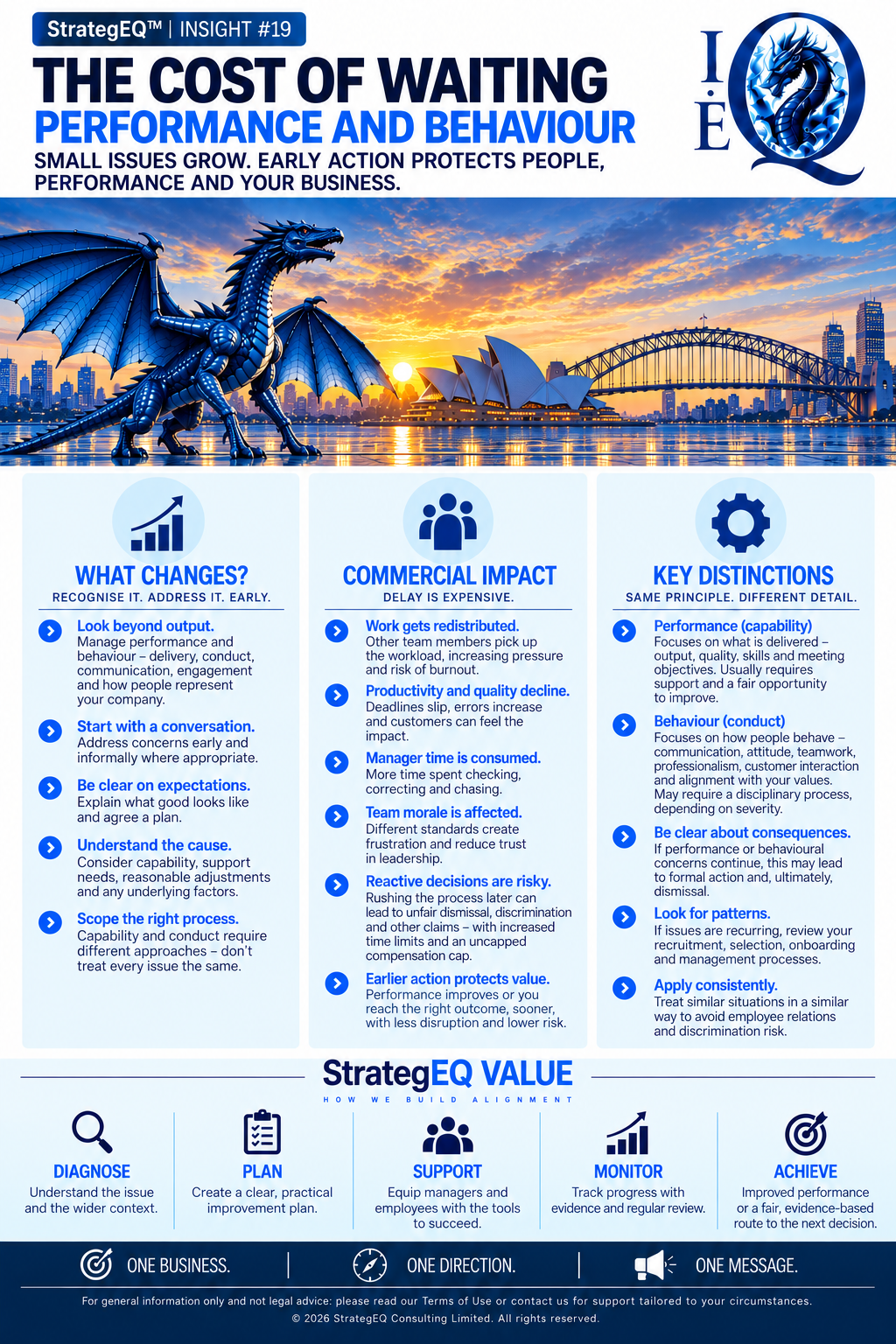
Work gets redistributed. Strong performers compensate. Managers spend increasing amounts of time checking, correcting and chasing. Deadlines can slip. Customers may feel the impact. Other employees see that apparently different standards are being tolerated. Poor behaviour can also affect team dynamics, customer relationships and how the company is represented.
Eventually, the manager reaches the point where they have had enough.
And that can create the second, potentially bigger, problem.
After tolerating performance or behavioural concerns for months, there is suddenly pressure to resolve the situation quickly. A process that could have started, supported improvement and potentially concluded months earlier is compressed into days or weeks. Expectations may not have been documented, feedback may have been inconsistent and the employee may never have been given a genuine opportunity to improve.
If the company had acted earlier, one of two things might already have happened: the employee would be performing and behaving at the required standard, or the company would be much further through a fair process for addressing the fact that they are not.
Instead, commercial frustration drives a reactive employment decision.
That is why early intervention matters. It is not about moving quickly towards dismissal. It is about identifying the concern early enough that there is still a realistic opportunity to fix it, while protecting your people, performance, business and reputation if improvement does not follow.
START WITH THE CONCERN, NOT THE LABEL
Identify what is actually happening before deciding how to manage it.
The concern may be about performance: • quality or accuracy of work; • productivity or output; • missed deadlines or commitments; • capability or technical competence; • customer delivery; or • failure to achieve agreed objectives.
Or it may be about behaviour: • communication with colleagues or customers; • conduct or professionalism; • collaboration and contribution to the team; • reliability or accountability; • inappropriate or disruptive behaviour; • engagement with colleagues, managers or stakeholders; • how somebody represents the company internally or externally; or • behaviour inconsistent with clearly communicated company expectations or values.
Sometimes the two overlap. Poor communication, for example, may affect performance without necessarily amounting to misconduct.
The important thing is to diagnose the concern before choosing the process.
START INFORMALLY WHERE APPROPRIATE
Not every concern needs an immediate formal process. For lower-level performance or behavioural issues, early informal intervention may prevent the situation becoming more serious.
- Explain the concern
- Be specific about what has happened.
- Give examples rather than general impressions.
- Avoid vague labels such as “poor attitude” or “not engaged”.
- Describe the impact
- Explain what it means for delivery, colleagues, customers, cost, management time or the company’s reputation.
- Set the expectation
- Explain what needs to change.
- Define what acceptable performance or behaviour looks like.
- Make it measurable or observable where possible.
- Understand the cause
- Listen to the employee’s perspective.
- Do not assume poor performance automatically means poor attitude.
- Establish whether underlying circumstances need consideration.
- Consider capability and support
- Is there a skills or knowledge gap?
- Was onboarding sufficient?
- Are priorities clear?
- Does the employee have the tools and resources required?
- Would training, coaching or clearer management support help?
- Consider individual circumstances
- Are health or disability issues relevant?
- Could reasonable adjustments be required?
- Is another circumstance affecting performance or behaviour that needs to be understood?
- Set a timeframe and review point
- Confirm the required change, support and timescale.
- Make sure both sides know when progress will be reviewed.
- Be clear about the consequences
- If ongoing performance or behavioural concerns remain an issue, say so.
- Explain that failure to achieve and sustain the required improvement may lead to formal action.
- Where appropriate, be explicit that the ultimate consequence could include dismissal.
Managers sometimes soften the message so much that the employee does not understand the seriousness of the situation. If formal action then follows, the employee may genuinely feel blindsided.
Clarity is fairer to everybody.
MAKE BEHAVIOURAL EXPECTATIONS OBSERVABLE
Behaviour needs evidence too.
Instead of saying “you need to communicate better”, explain what that means. For example: • acknowledge customer communication within the agreed timeframe; • escalate concerns rather than leaving them unanswered; • communicate professionally when disagreeing; • attend agreed team meetings; • provide colleagues with information they need; • challenge appropriately rather than personally; • follow through on agreed actions; and • communicate delays early.
The model remains simple:
Concern → Required standard → Support → Review → Consequence if it does not change.
PERFORMANCE STARTS BEFORE SOMEBODY UNDERPERFORMS
Assume, as a starting point, that your recruitment and selection process is designed to identify people capable of succeeding in the role.
If somebody subsequently struggles, consider the individual circumstances, but also examine the parts of the system the company controls.
- Recruitment
- Where are we finding candidates?
- Are we attracting the right profile?
- Does the job description reflect the role people actually perform?
- Selection
- Are interview questions testing the capabilities that genuinely matter?
- Are assessments predictive of the work?
- Are managers selecting consistently or relying too heavily on instinct?
- Onboarding
- Were expectations clear from the beginning?
- Did the employee receive sufficient role, company and system knowledge?
- Was there a structured route to productivity?
- Management
- Are objectives clear?
- Is feedback regular?
- Are priorities constantly changing?
- Does the manager intervene early when delivery or behaviour slips?
- Role and environment
- Has the job changed?
- Are workload, resources or dependencies realistic?
- Are reasonable adjustments or other support required?
One underperforming employee may be an individual issue.
A pattern should trigger a broader question.
If several people recruited into the same role struggle, probation failures repeatedly occur under one manager or new hires consistently take longer than expected to become productive, stop treating every case as an isolated performance problem.
Take the conversation back to the beginning:
Source → Recruit → Select → Onboard → Manage → Measure → Improve
Performance management is not simply correcting the person at the end of that chain. The whole process should connect.
IF INFORMAL INTERVENTION DOES NOT WORK
Where the employee understands the expectations, appropriate support has been provided and sufficient improvement does not follow, escalation may be appropriate.
A formal process should remain straightforward: • define the performance gap or behavioural concern; • set measurable or observable improvement expectations; • provide appropriate support; • set a reasonable timeframe; • review properly and use evidence; • give the employee an opportunity to respond; • document concerns, conversations, support, expectations and outcomes; and • be clear about the consequences, up to and including dismissal where appropriate.
A formal performance process should be a genuine opportunity to improve, not paperwork constructed afterwards to justify a decision already made.
DON’T FORCE EVERY ISSUE THROUGH THE SAME PROCESS
Performance or capability and conduct are not interchangeable.
A genuine capability issue will normally require a reasonable opportunity and appropriate support to improve.
Misconduct may require a disciplinary process. Serious allegations require appropriate investigation, and sufficiently serious misconduct may potentially amount to gross misconduct.
The starting framework is still useful:
What is the concern? → What evidence do we have? → What standard applies? → What is causing it? → What is the appropriate process?
The route from there may differ.
CONSISTENCY MATTERS
Apply the process consistently across the company.
Do not tolerate the same performance or behavioural issue indefinitely because somebody is a favourite, historically a high performer or close to a senior leader, while managing another employee aggressively for similar concerns.
Apart from damaging trust, inconsistent treatment can create additional employee-relations and discrimination risk.
Measure contribution against what actually matters in the role and apply expectations consistently.
THE COMMERCIAL PAYOFF
Handled early, performance and behavioural management gives the company two useful outcomes.
Performance or behaviour improves: capability is retained, productivity recovers, management intervention reduces, customer and team impact is contained, reputation is protected and replacement cost is avoided.
Or improvement does not follow: the company has clear evidence of the concern, the support provided and the reasonable opportunity given to improve, allowing the next decision to be made from a substantially stronger position.
Either is better than allowing concerns to drift until somebody loses patience.
And if problems repeatedly appear in the same team, role or hiring cohort, broaden the diagnosis. The problem may not simply be the employee sitting in front of you.
Recruit well. Onboard properly. Set clear performance and behavioural expectations. Manage consistently. Intervene early. Look for patterns. Fix the process as well as the individual problem.
When somebody is falling short, tell them clearly what the concern is, what needs to change, what support is available and what will happen if it does not.
The objective is improvement. But where reasonable improvement does not happen, the company also needs to be prepared to act.
Ongoing performance or behavioural concerns can ultimately result in dismissal. That should never come as a surprise at the end of the process.