
Approx. 7-minute read
RIGHT TO WORK CHANGES TOMORROW.
If you employ people in the UK, I am probably not telling you something you don't already know.
But knowing that the rules change on 1 October 2026 and understanding how far those changes could reach across your business are two different things.
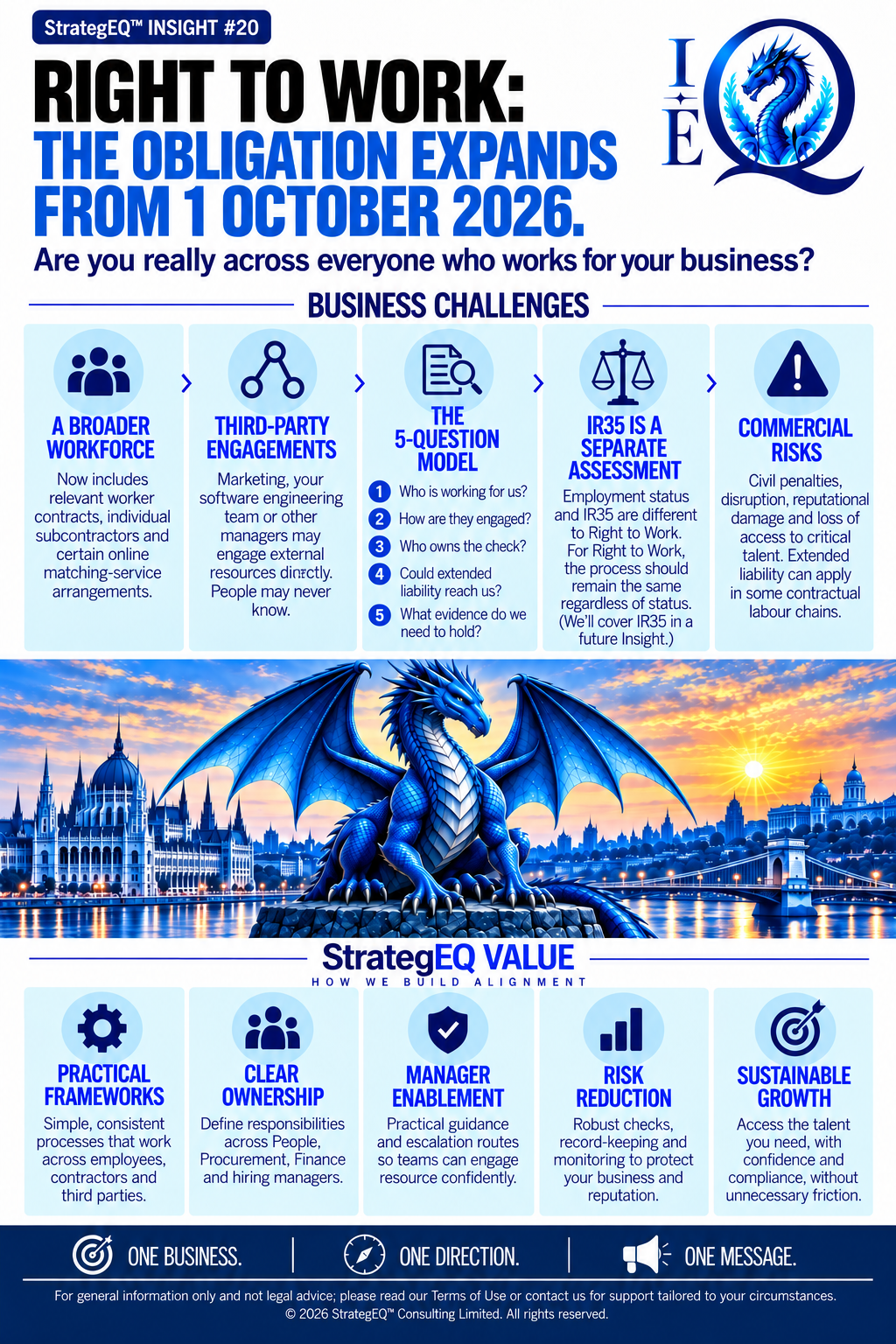
The important change is not simply another update to the employee onboarding process. The Right to Work regime expands beyond conventional employees to relevant worker contracts, individual subcontractors and certain online matching-service arrangements, alongside extended-liability provisions affecting some contractual labour arrangements.
And that is where companies can have a blind spot.
Your People team probably knows who your employees are. But do they know about the freelance web designer Marketing engaged directly? The specialist brought into the software engineering team for a release? The individual consultant engaged by a senior leader whose invoice simply goes to Finance?
A process owned entirely by People cannot control engagements People never see.
So with the changes taking effect tomorrow, the practical question is no longer simply:
“Have we checked our employees?”
It is:
“Who is working for us, how are they engaged, who owns the check, could extended liability reach us, and what evidence do we need to hold?”
That is the simple framework I use, and it is the focus of this Insight.
What changes from 1 October 2026?
The Right to Work scheme expands beyond conventional employment to relevant arrangements involving:
- employees;
- people working under worker contracts;
- individual subcontractors; and
- certain online matching services providing individual service providers to customers or clients.
For newly covered arrangements, the extended civil-penalty provisions apply where the relevant work starts on or after 1 October 2026. There are also extended-liability provisions affecting some contractual labour arrangements entered into from that date.
That distinction matters. This is not a blanket instruction to retrospectively recheck every historic contractor on 1 October.
It does mean companies need to understand which arrangements fall within scope and put the appropriate controls around them.
Start by mapping who actually performs work for you
Do not begin and end with the payroll list.
Consider the wider workforce, including:
- employees;
- workers;
- individual contractors and subcontractors;
- agency arrangements;
- consultants;
- platform or gig-economy arrangements;
- people supplied through online matching services; and
- arrangements allowing substitution.
Not every business-to-business purchase of services falls within the expanded regime. A genuinely independent business providing services in its own right may sit outside the relevant provisions.
The facts and how the arrangement actually operates matter.
A simple model for every engagement
A Right to Work responsibility map is not a statutory requirement. It is a practical framework I like to use because it reduces a complicated issue to five simple questions:
- Who is working for us?
- How are they engaged?
- Who owns the Right to Work check?
- Could extended liability reach us?
- What evidence do we need to hold?
The value is consistency. The same questions can be applied to an employee, contractor, subcontractor, agency worker, platform worker or a new workforce model that appears later.
It also means the process does not depend entirely on one person understanding every possible contractual arrangement. Managers, People, Procurement and Finance have a common framework for identifying when something needs further review.
Where another business performs the prescribed check, establish what your company needs to protect its own position. Depending on the arrangement, that may include contractual requirements, controls over further subcontracting, audit rights, supplier assurance, substitution controls and evidence that the person performing the work is the person whose Right to Work was checked.
The framework also exposes ownership gaps. If Procurement believes the supplier owns the issue, People has never seen the engagement, Finance simply pays the invoice and the operational manager assumes somebody checked the individual, four functions may be involved while nobody is actually accountable.
This is more than a People process
A process owned entirely by the People team cannot control engagements the team is unaware of.
Marketing may have discretionary budget and engage an external event planner, photographer, web designer or other specialist directly. A software engineering team may bring in an individual specialist to flex resource around a release or project. A senior leader may engage a consultant because they need expertise quickly.
The internal process can become:
Manager identifies resource → individual performs work → invoice goes to Finance → payment is made.
People may never know the engagement exists.
There are two separate questions here, and they should not be confused.
The first is employment status and tax treatment, including whether IR35/off-payroll working rules apply. That is a separate subject and one we will cover in another StrategEQ Insight.
The second is Right to Work.
For the purposes of Right to Work, do not assume that calling somebody a contractor, paying them against an invoice or keeping them outside payroll answers the question.
Apply the same five-question framework.
Their employment or tax status may require a separate IR35 assessment, but that does not replace the need to establish whether the arrangement falls within the expanded Right to Work regime and where responsibility sits.
The practical benefit is that Marketing, Software Engineering, Finance, Procurement, People and other managers do not need to become immigration specialists. They need to recognise that an external individual is being engaged, apply the same initial questions and know when the arrangement requires further review.
Who actually owns the check?
Start with the contractual chain.
Ask who directly employs or engages the individual and who is responsible for carrying out the prescribed Right to Work check.
Where your company sits elsewhere in an in-scope contractual chain, the answer may not be to duplicate the individual’s check. Instead, your company may need the appropriate contractual and assurance controls to establish its own statutory excuse against extended liability.
Depending on the arrangement, that can include:
- written requirements for the relevant supplier to complete prescribed Right to Work checks;
- controls over further subcontracting;
- equivalent obligations further down the supply chain;
- audit rights;
- provisions dealing with illegal working;
- substitution controls; and
- appropriate identity assurance.
A contractual clause alone is not a functioning control. Make sure the process operates in practice and retain appropriate evidence.
What does a compliant check look like?
The appropriate prescribed route depends on the individual’s circumstances and can include:
- a Home Office online Right to Work check using a share code;
- a prescribed manual document check;
- an appropriate digital verification service where permitted; or
- the Employer Checking Service in applicable circumstances.
The check needs to happen at the correct time, using the prescribed process, with the required evidence retained.
Where permission is time-limited, appropriate follow-up checks may be required to retain the statutory excuse.
GOV.UK — Check a job applicant’s Right to Work: https://www.gov.uk/check-job-applicant-right-to-work
In practice, it usually makes commercial sense to establish Right to Work considerably earlier than day one. There is little value in taking a candidate through an extended recruitment process, consuming significant candidate and company time, only to discover at the end that the proposed employment cannot proceed.
Identity matters after the check too
A compliant process also needs to consider whether the person actually performing the work is the person whose Right to Work was checked.
This is particularly relevant where substitution is permitted or where individuals enter the business through more complex contractual arrangements.
Controls should be proportionate to the operating model. The objective is not unnecessary surveillance. It is to make sure the Right to Work control functions in reality rather than existing only on paper.
Do not create a discrimination problem while solving an immigration one
Right to Work processes need to be applied consistently.
The trigger for checking should be the working arrangement and the scheme requirements, not assumptions based on somebody’s nationality, ethnicity, accent or perceived immigration status.
Companies also need to make sure that different legitimate checking routes do not result in candidates or workers being treated less favourably.
What should companies do before 1 October 2026?
- Map the different ways people perform work for the company.
- Apply the five-question responsibility framework.
- Identify teams that can engage external resources without People involvement.
- Review contractor, subcontractor, agency, platform and substitution arrangements.
- Establish who owns each prescribed check.
- Review contractual protections and audit rights where extended liability could apply.
- Put appropriate evidence-retention and follow-up controls in place.
- Build Finance and Procurement into the control where appropriate.
- Communicate the change to managers.
- Give managers a simple escalation route before they engage somebody directly.
- Apply the process consistently and without discriminatory assumptions.
Flexible workforce models are commercially valuable. They give growing companies access to specialist capability, allow resource to flex with demand and can avoid unnecessary fixed cost.
The objective is not to make that harder. It is to make sure flexibility does not create invisible engagements and unclear accountability.
A process owned entirely by People cannot control engagements People never see.
Make the responsibility visible, educate the people who can engage resource and put a simple control at the point where the engagement actually begins.
Know who is working for you. Know how they are engaged. Know who owns the check. Understand whether extended liability can reach you. Keep the evidence.
From 1 October 2026, that discipline matters across a considerably broader range of working arrangements.