Approx. 7-minute read
Different goals. Different questions. Better decisions.
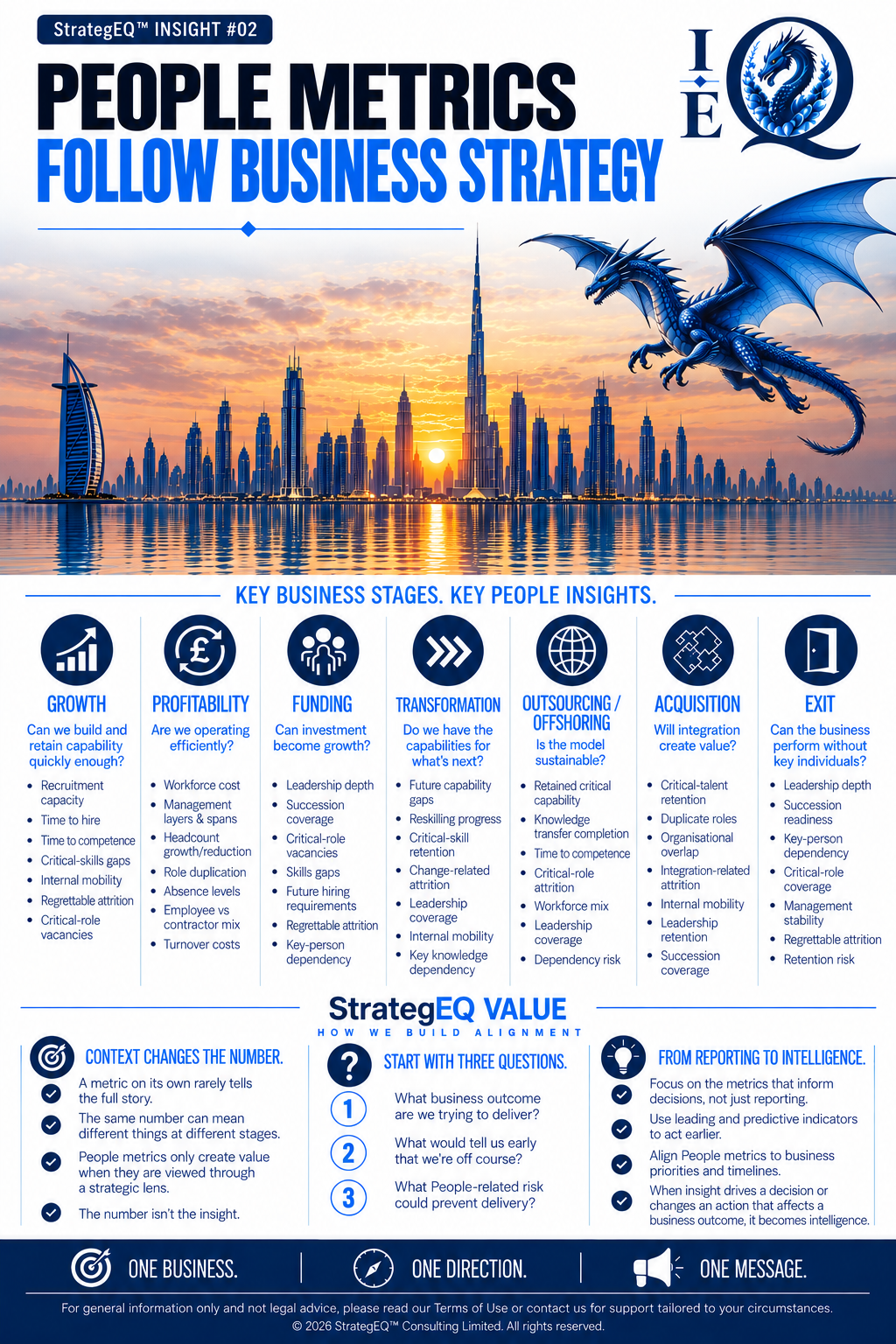
People metrics should help leaders understand whether the company has the workforce capability, capacity and resilience to deliver its strategy, where people-related risk could constrain execution, and where action could improve the commercial outcome.
That is very different from producing an HR dashboard.
Headcount, turnover, engagement, absence and time to hire can all be useful measures. But collecting them because they are available, easy to report or traditionally owned by People does not make them strategically valuable.
The starting point should not be "What People metrics should we report?" It should be "What is the company trying to achieve, and what do we need to understand about our people to help deliver it?"
STRATEGY DETERMINES WHAT MATTERS
The People agenda should not operate independently of the business agenda. It should translate company priorities into the workforce questions, risks and decisions that matter.
As the strategy changes, the People metrics should change with it.
GROWTH
A growth strategy creates a fundamental workforce question: can we build and retain the capability required quickly enough?
Relevant People metrics might include:
- recruitment capacity and time to hire;
- offer acceptance and candidate conversion;
- time to competence;
- critical-skills gaps;
- internal mobility;
- regrettable attrition; and
- critical-role vacancy levels.
If the growth plan requires 30 additional specialist roles but those roles consistently take six months to recruit, the People data is identifying a potential constraint on the strategy. The commercial value is not knowing the average time to hire. It is knowing whether hiring capability can support the growth assumptions the company has made.
PROFITABILITY
When profitability becomes the priority, the People lens changes. The question becomes whether workforce structure and cost support a more efficient operating model.
Relevant measures might include:
- workforce cost and workforce cost as a percentage of revenue;
- management layers and spans of control;
- headcount growth or reduction;
- role duplication and organisational complexity;
- regrettable and non-regrettable attrition;
- absence and associated workforce cost;
- employee versus contractor mix; and
- recruitment, turnover and replacement costs.
These remain People metrics. Their value comes from understanding them in the context of the profitability objective. Reducing headcount, for example, may lower immediate workforce cost but create a different commercial problem if scarce capability is lost, contractor dependency increases or critical roles subsequently need to be replaced at significantly greater cost. People does not need to own the P&L to understand how workforce decisions affect it.
FUNDING
Funding creates another set of workforce questions. Does the company have the people capability to turn investment into growth?
The People team might therefore focus on:
- leadership depth;
- succession coverage;
- critical-role vacancies;
- skills gaps;
- future hiring requirements;
- regrettable attrition; and
- key-person dependency.
A company may have an ambitious investment plan, but if delivery depends heavily on a handful of individuals or requires capabilities that are difficult to recruit, that is commercially relevant information. People data can expose the gap between the investment proposition and the workforce required to deliver it.
TRANSFORMATION
Transformation changes what the company needs from its workforce, so measuring the current state alone is insufficient.
The relevant People metrics may include:
- future capability gaps;
- reskilling and redeployment progress;
- critical-skill retention;
- change-related attrition;
- leadership coverage;
- internal mobility; and
- dependency on individuals holding critical knowledge.
A transformation programme can appear to be progressing while the company quietly loses the capability required to make the future operating model work. People metrics should provide visibility before that risk becomes an operational problem.
OUTSOURCING AND OFFSHORING
Outsourcing and offshoring may start with a commercial case, but successful execution often depends on what happens to capability and knowledge.
Relevant People measures might include:
- retained critical capability;
- knowledge-transfer completion;
- time to competence;
- critical-role attrition;
- key-person dependency;
- employee and contingent-worker mix; and
- leadership coverage across locations.
The headline financial case may be compelling. The People data helps establish whether the workforce transition supporting it is sustainable.
ACQUISITION
An acquisition may create value financially before it creates value organisationally.
People metrics can provide early visibility of whether critical capability is being retained and whether the combined workforce is developing as expected. Measures might include:
- critical-talent retention;
- duplicate and overlapping roles;
- leadership retention;
- organisational overlap;
- acquisition-related attrition;
- internal appointments and mobility; and
- succession coverage.
An overall attrition figure may look perfectly acceptable while a small number of people holding key technical knowledge, customer relationships or specialist capability are leaving. The headline number is not enough. Context changes the number.
EXIT
As a company approaches exit, workforce resilience becomes increasingly important. The People questions shift towards whether the business can continue to operate effectively without disproportionate reliance on its founder, senior leaders or a small number of critical individuals.
Useful measures might include:
- leadership depth;
- succession readiness;
- key-person dependency;
- critical-role coverage;
- management stability;
- regrettable attrition; and
- retention risk in strategically important roles.
These measures help expose concentration of capability and knowledge that may otherwise remain invisible.
LEADING, LAGGING AND PREDICTIVE
Good People intelligence should not simply explain what has already happened.
Lagging indicators describe an outcome. Someone resigned. Turnover increased. Absence rose. A critical vacancy remained open for six months. They matter, but the event has already happened.
Leading indicators can provide earlier warning. Offer acceptance is deteriorating. Internal mobility has fallen. Critical-role vacancies are increasing. Engagement is declining in a strategically important team. Management turnover is rising. These signals create an opportunity to intervene before the full commercial impact is felt.
The next step is predictive People intelligence: combining measures to identify where risk or opportunity may be emerging. A declining engagement score alone may tell you relatively little. Combine it with increasing absence, low internal mobility, manager changes, lengthening tenure in role and historical patterns of regrettable attrition, and the picture becomes more useful.
Predictive does not mean pretending the data can tell us the future with certainty. It means using the information available to identify patterns, test assumptions and make better-informed decisions earlier.
THE NUMBER IS NOT THE INSIGHT
A company can have low attrition and still have a serious retention problem if the few people leaving hold disproportionately important capability. High attrition is not automatically negative either. During significant transformation, some workforce movement may reflect deliberate changes in the capabilities the company needs.
An eNPS score can indicate sentiment but cannot, on its own, explain why people feel that way, which groups are affected or whether intervention is required. Headcount tells you how many people work for the company. It does not tell you whether they have the capabilities required for the next stage of the strategy.
The metric provides evidence. Context creates insight.
FROM REPORTING TO INTELLIGENCE
Before deciding what belongs on a People dashboard, ask three questions:
- What business outcome are we trying to deliver?
- What People indicator would tell us early that we may be moving off course?
- What People-related risk could materially prevent delivery?
Then decide what to measure.
This also means being prepared to stop reporting measures that no longer answer a strategically relevant question. A company pursuing aggressive growth should not automatically use the same People dashboard when its priority moves to profitability, transformation, acquisition or exit.
The business has changed. The questions have changed. The measures should change too.
A dashboard containing 40 People metrics that nobody acts on creates less value than five indicators that cause leaders to ask the right question early enough to do something about it. Without strategic context, a metric is simply a number. Without ownership or action, it is reporting.
When People data identifies a material workforce risk, highlights an emerging opportunity or changes a decision that affects delivery of the company strategy, it becomes intelligence.
That is where People metrics add commercial value.
People strategy should not sit alongside business strategy as a separate agenda. It should help deliver it.
Different goals. Different questions. Better decisions.