Approx. 10-minute read
MAKE AWARENESS INTRINSIC
October gives us a timely reason to talk about ADHD.
1 November isn't an expiry date.
The strengths don't disappear. The challenges don't disappear. The employee doesn't become less neurodivergent. The manager's responsibilities don't disappear. The legal obligations don't disappear.
And the commercial opportunity doesn't disappear.
Awareness days and months can start useful conversations. But neurodiversity isn't a campaign, an annual initiative or something to think about for 31 days.
It is already part of your workforce, your candidate pool, your customers and potentially your leadership team.
The opportunity is to make understanding difference intrinsic to how you recruit, structure work, manage performance, develop talent and lead teams.
Because this isn't simply about inclusion.
It is about accessing capability and creating the conditions in which it can perform.
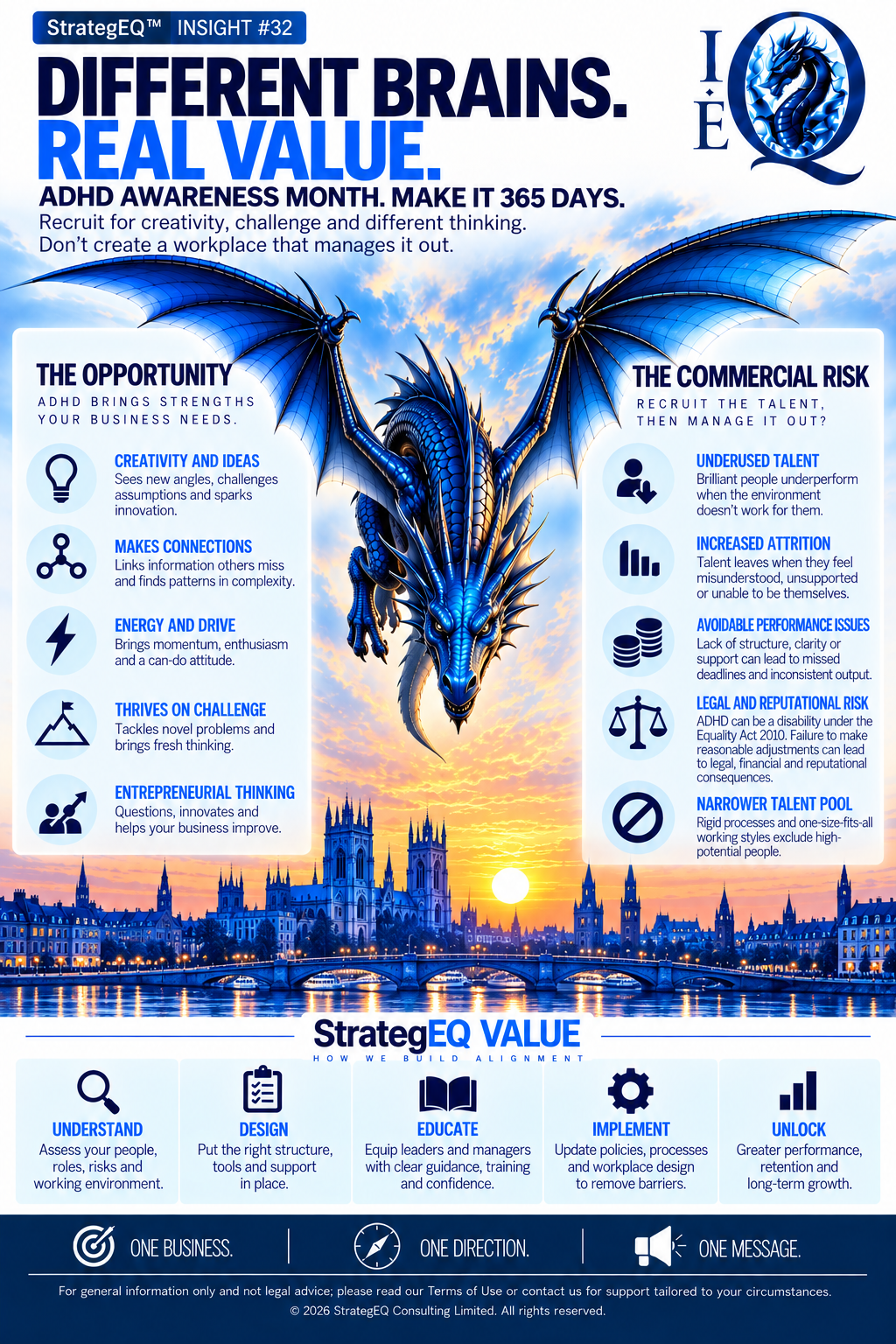
THE COMMERCIAL OPPORTUNITY
Look at the capabilities businesses say they need, particularly in start-ups, scale-ups, transformation and high-growth environments:
- Creativity and original thinking
- Energy and momentum
- Entrepreneurial instinct
- Rapid problem-solving
- Comfort with challenge and change
- Connecting information others may not immediately link
- Questioning established ways of working
- Intense focus when highly engaged
- Finding another route when the obvious one fails
Sound familiar?
Fast-paced, dynamic, constantly changing environments can play particularly well to some ADHD traits. Not for everyone, and not all the time, but there can be a significant overlap between the characteristics businesses actively recruit for and strengths experienced by some people with ADHD.
Give the right person:
- A difficult customer problem to solve
- A new proposition to build
- An urgent commercial challenge
- A complex restructure or integration project to manage
- A broken process nobody has managed to fix
- An ambitious deadline
- A blank sheet of paper and permission to rethink something
…and you may see extraordinary engagement, creativity and focus.
Give that same person three months of expenses to reconcile or a twelve-month data audit to work through, and getting started may feel disproportionately difficult.
Both still need to be done.
The answer isn't removing accountability. It is understanding what creates engagement, what creates friction, and putting the right structure around both so the required outcome is delivered.
The commercial objective is straightforward:
Get the best from the talent you've already hired.
RECRUIT DIFFERENCE. DON'T MANAGE IT OUT.
There is a contradiction worth examining.
Businesses recruit people because they are creative, energetic, challenging, entrepreneurial and different.
Then sometimes place them into working environments built around:
- Long lists of competing priorities
- Constant interruptions
- Back-to-back meetings
- Verbal instructions with little follow-up
- Ambiguous deadlines
- Repetitive processes with little visible purpose
- Noisy open-plan offices
- Expectations that everyone should organise, concentrate and process information in broadly the same way
You can recruit precisely the difference your business needs and then create an environment that prevents it from thriving.
That's not simply an inclusion issue. It's a commercial one.
DIFFERENT DOESN'T MEAN UNIVERSALLY BETTER
ADHD shouldn't be romanticised.
Not everybody with ADHD is creative, entrepreneurial or comfortable in a start-up. ADHD can create genuine challenges and its impact varies significantly between individuals.
Equally, it shouldn't be viewed solely through a deficit lens.
Entrepreneurs including David Neeleman, founder of JetBlue, Paul Orfalea, founder of Kinko's, and entrepreneur and author Peter Shankman have publicly discussed their ADHD and the ways they have structured work around how they operate.
ADHD didn't make them successful.
Their examples simply challenge the assumption that different cognitive wiring is inherently a limitation.
Understand the individual before deciding what needs fixing.
REMOVE THE BARRIER. KEEP THE STANDARD.
Physical barriers are often easier to recognise.
Imagine recruiting an exceptional commercial leader who has a physical impairment that prevents them climbing three flights of stairs.
You wouldn't assess their ability to lead the commercial function by repeatedly asking them to walk up the stairs.
You would identify the barrier and consider a reasonable way around it.
Their accountability for leading the function hasn't changed. The barrier has.
The same principle applies to neurodiversity. The barriers may simply be less visible:
- Sensory overload
- Competing priorities
- Difficulty initiating repetitive work
- Unstructured verbal information
- Constant interruptions
- Unclear expectations
- Poorly defined deadlines
- Excessive context switching
The question isn't “How do we make the job easier?”
It is: “What is getting between this person and the outcome the business needs?”
START WITH THE INDIVIDUAL
Support shouldn't mean something being done to somebody. The individual has responsibility too.
Understanding personal patterns can be powerful:
- When do I produce my best work?
- What consistently gets delayed?
- What creates focus?
- What destroys it?
- Which tasks do I repeatedly struggle to start?
- Which environments affect my concentration?
- Do I process information better when it is written down?
- Would visual priorities help?
- Does batching routine work improve completion?
- Which systems can I put around the things I know I find difficult?
Back to those expenses or that data audit.
A recurring diary block. Notifications off. Headphones where helpful. A defined work sprint. Automated reminders. A visible deadline. Routine administration batched together. Progress broken into smaller, measurable stages.
Same work. Same requirement.
Better mechanism for delivering it.
GIVE MANAGERS PRACTICAL TOOLS
Managers don't need to become ADHD specialists. They need to become better at managing individuals.
That can mean:
- Agreeing the top three priorities rather than continually adding to an undifferentiated list
- Separating genuinely urgent work from everything labelled urgent
- Giving explicit deadlines
- Confirming important verbal instructions in writing
- Breaking large deliverables into milestones
- Using short, regular checkpoints
- Connecting routine work to its commercial purpose
- Protecting periods of uninterrupted focus
- Asking what helps rather than assuming
- Giving clear feedback early, before something becomes a performance issue
This isn't soft management.
It is proactive performance management.
DESIGN THE ENVIRONMENT, NOT JUST THE INDIVIDUAL
For someone affected by sensory input, an open office can mean trying to concentrate while simultaneously processing conversations, phones, movement, notifications, people approaching their desk and meetings repeatedly breaking concentration.
Telling somebody to “focus” doesn't remove those inputs.
Practical support might include:
- Noise-cancelling headphones
- Quiet working areas
- Protected focus periods
- Fewer unnecessary notifications
- Choice over seating
- Remote working for concentration-heavy tasks where appropriate
- Shorter meetings with clear agendas
- Written actions following meetings
- Fewer unnecessary meetings
- Advance warning of significant changes where practicable
Many of these approaches don't need to be restricted to people with ADHD.
Clear priorities, fewer interruptions, better meetings and clearer communication can improve performance across the team.
HARNESS STRENGTHS DELIBERATELY
Don't make neuroinclusion entirely about mitigating difficulties.
Look for where difference creates VALUE:
- Who thrives on complex problems?
- Who spots connections others miss?
- Who generates ideas quickly?
- Who challenges assumptions?
- Who becomes highly engaged when the stakes increase?
- Who brings energy when momentum has stalled?
- Who can navigate ambiguity?
- Who asks “Why are we doing it this way?” when everybody else has accepted an inefficient process?
Then deliberately consider where those capabilities can create business advantage:
- Innovation and product development
- Complex transformation
- Restructures and integrations
- Problem-solving
- Customer escalation
- Business development
- Crisis response
- Process redesign
- Creative strategy
- Building something from zero
The objective isn't to create a role containing only stimulating work. Every role contains things we'd rather not do.
The opportunity is to understand where somebody can create disproportionate VALUE, while building enough structure around areas of friction to ensure the whole job still gets done.
KEEP ACCOUNTABILITY
Neurodiversity isn't a blanket explanation for every performance or conduct issue.
Support and accountability need to coexist:
- Keep the outcome
- Keep appropriate standards
- Keep genuine deadlines
- Keep accountability
- Challenge unnecessary barriers
If a proposal genuinely needs to be delivered by Friday, Friday may remain the deadline.
What may not be essential is requiring someone to deliver it while sitting in a distracting environment, holding multiple verbal instructions in their head, responding continuously to messages, managing numerous supposedly equal priorities and working exactly as their manager would.
Separate the business outcome from assumptions about the route to achieving it.
UNDERSTAND THE COMMERCIAL RISK
Talent, capability & innovation
- Talent: recruit scarce, creative and differently wired capability, then fail to create the conditions in which it can deliver its full value.
- Innovation: recruit creativity, challenge and entrepreneurial thinking, then create an environment that rewards conformity.
- Leadership pipeline: overlook high-potential people because their organisational or communication style differs from traditional expectations of leadership.
- Change & transformation: underuse people who may thrive on novelty, ambiguity, complex restructures, integrations and fast-moving problems precisely when those capabilities are most valuable.
Performance, productivity & execution
- Performance: interpret difficulties with prioritisation, administration, sensory overload or task initiation as lack of capability without understanding whether the working environment is contributing.
- Productivity: lose valuable time to interruptions, excessive context switching, unclear priorities or poorly structured work.
- Execution: allow competing priorities, ambiguous ownership or unclear deadlines to prevent capable people converting ideas and expertise into consistent delivery.
- Customer impact: lose the contribution of people who may excel at solving complex problems, challenging assumptions and responding rapidly when customers need a different approach.
Management, team & culture
- Management: leave managers without the confidence or practical tools to distinguish between capability, behaviour, performance and a barrier that could reasonably be addressed.
- Team: allow inconsistent expectations or poorly explained ways of working to create confusion rather than managing outcomes consistently.
- Engagement: repeatedly focus on areas of difficulty while overlooking where an individual creates disproportionate value.
- Culture: say that different thinking is valued at recruitment, then signal that conformity is expected once somebody joins.
Attraction, retention & cost
- Recruitment: design selection processes around one preferred communication, concentration or working style and screen out capable candidates.
- Retention: lose talented employees because manageable workplace barriers remain unresolved, taking capability, knowledge and relationships with them.
- Replacement cost: incur further recruitment, onboarding, training and lost productivity replacing talent that better management or relatively straightforward adjustments might have retained.
- Absence: allow unresolved workplace pressures or sensory demands to contribute to avoidable stress, disengagement or absence.
Legal, employee relations & reputation
- Equality: ADHD can meet the Equality Act 2010 definition of disability depending on the individual's circumstances, bringing potential duties around reasonable adjustments and protection from disability discrimination.
- Employee relations: allow something potentially resolvable through early conversation and practical support to escalate into formal performance, grievance, absence or legal processes.
- Reputation: promote neurodiversity, inclusion and different thinking externally while the employee experience tells a different story.
Commercial opportunity
- Lost VALUE: invest in finding people who think differently, fail to harness what makes them different, and lose the creativity, innovation, challenge and problem-solving capability you recruited them to provide.
You can pay to recruit difference, fail to enable it, manage it as a problem and ultimately lose the very capability you hired.
EQUALITY DOESN'T MEAN IDENTICAL
Fair does not always mean identical.
We understand that intuitively when the barrier is visible.
Someone who cannot climb three flights of stairs isn't gaining an unfair advantage because an accessible route is provided.
Their performance standard hasn't changed. The unnecessary barrier has been addressed.
The same principle applies when the barrier isn't visible.
The commercial requirement might be: Deliver the proposal by Friday.
It probably isn't: Deliver the proposal by Friday while sitting in a noisy open-plan office, processing every instruction verbally, responding continuously to notifications and keeping 17 competing priorities in your head.
Ask what is genuinely essential to the role and outcome.
Then distinguish it from the way things have simply always been done.
StrategEQ VALUE
UNDERSTAND
The individual, their strengths, the role, the environment and where VALUE is being created or lost.
DESIGN
Work with enough clarity, structure and flexibility to enable consistent delivery.
EDUCATE
Managers and teams to understand difference, challenge assumptions and manage individuals effectively.
IMPLEMENT
Practical support, better working practices and reasonable adjustments where appropriate.
UNLOCK
Creativity, innovation, performance, retention and the wider commercial VALUE different thinking can bring.
If your business says it wants people who are creative, entrepreneurial, energetic, innovative, agile, challenging and capable of seeing what others miss, make sure the environment you create allows those characteristics to survive.
Recruit difference. Harness it. Don't manage it out.
Awareness creates a moment. Making it intrinsic creates VALUE.