Approx. 5-minute read
Culture has a commercial consequence.
It determines how quickly decisions are made, whether accountability is real, whether problems are surfaced early, how consistently managers lead and whether talented people can perform at their best.
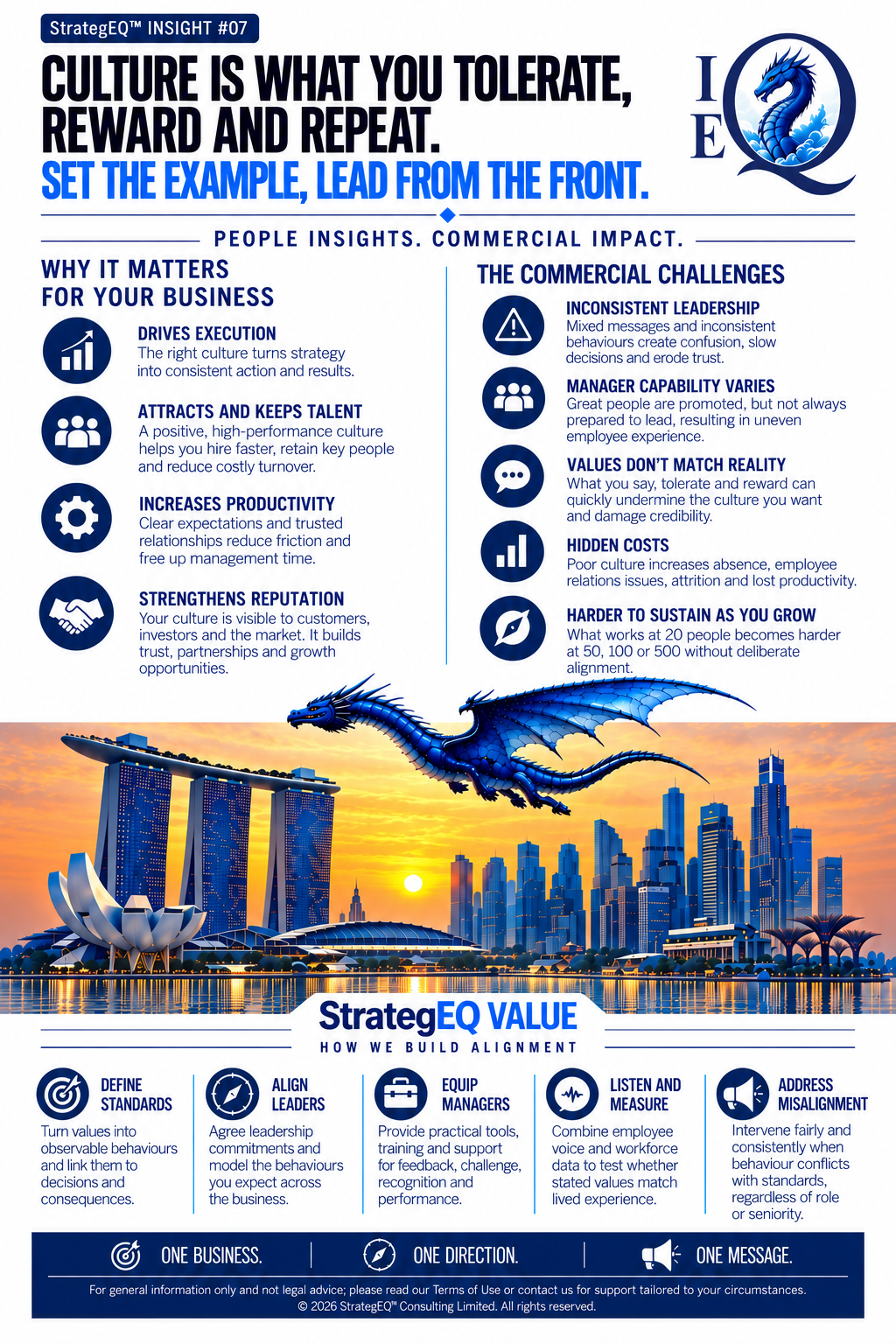
As a company grows, those behaviours become increasingly important. What worked through proximity, founder influence and informal communication at 20 people becomes harder to sustain at 50, 100 or 500. Without deliberate alignment, different teams can develop different standards, different management experiences and eventually different versions of the company.
Culture therefore isn't simply about engagement or whether people enjoy working somewhere. It is part of the operating environment through which strategy gets executed.
Culture is what you tolerate, reward and repeat.
Culture is shaped by everyone, but leadership sets the conditions
Everyone contributes to culture, but responsibility is not equal.
Leaders have disproportionate influence because people watch what they do, particularly when pressure increases. The behaviours that leaders tolerate can become as influential as the behaviours they actively encourage.
Managers then translate those expectations into everyday employee experience. They allocate work, give feedback, make decisions, recognise contribution, challenge performance and respond when behaviour falls below expectations.
Employees reinforce or challenge those norms through thousands of everyday interactions.
The People function can define frameworks, develop managers, identify patterns and measure experience. It cannot compensate indefinitely for leadership behaviour that contradicts the culture the company says it wants.
If collaboration is a stated value but individual heroics are consistently rewarded, employees learn what matters.
If accountability is expected but missed commitments carry no consequence, the standard becomes optional.
If leaders ask for challenge but react badly when challenged, people learn to remain silent.
The lived behaviour wins.
Culture is created every day
Culture is not created when values are launched. It is created through repetition.
Strategy establishes priorities. Incentives demonstrate what the company values. Performance expectations establish standards. Communication provides context. Leadership behaviour shows employees whether all of those things genuinely matter.
This becomes particularly important during growth and change.
As companies scale, informal cultural transmission becomes less reliable. Founders cannot personally explain every decision. New managers emerge. Teams become geographically dispersed. More people join without having experienced the company's earliest stages.
What once happened naturally needs greater clarity.
That does not mean creating bureaucracy. It means making expectations sufficiently explicit that people can operate with autonomy without creating completely different versions of the company across teams.
Employees experience culture rather than read it
Employees rarely judge culture primarily through corporate statements. They experience it through what happens to them and around them.
They notice whether expectations are fair and consistent. Whether they can raise a concern without being penalised. Whether good work is recognised. Whether poor behaviour is challenged regardless of seniority or commercial performance. Whether development and progression feel credible. Whether change is handled with respect. Whether people are treated with dignity when they leave.
These experiences accumulate.
One isolated management mistake does not necessarily define a culture. Repeated behaviour that goes unchallenged can.
That distinction matters commercially because inconsistent employee experience creates organisational friction. Managers spend time resolving problems that could have been prevented. Employee relations issues escalate. Trust falls. Valuable people leave. Recruitment becomes harder. Leadership credibility deteriorates.
The cost rarely appears neatly under a line labelled “culture”. It appears elsewhere in the business.
The data provides signals, not the whole answer
Culture can and should be measured, but no single metric proves that a culture is healthy.
Engagement and eNPS can indicate sentiment. Absence and employee relations data may reveal pressure points. Attrition and internal mobility can show where people are staying, leaving or progressing. Referral rates and exit insights add further context.
The important question is not simply whether a number has moved. It is why.
Company-wide averages can conceal significant differences between functions, locations, demographic groups or managers. A strong overall engagement result does not eliminate the possibility of a serious problem within one team.
Look for patterns across multiple sources rather than treating individual metrics as conclusions.
Listen to what employees say, examine what the workforce data shows and compare both against the behaviours the company claims to value.
Culture requires alignment
The commercial objective should not be to manufacture a universally “nice” culture.
Different businesses legitimately require different things from their people. A high-growth technology company may place greater emphasis on pace, experimentation and adaptability. A highly regulated business may require stronger controls, documentation and challenge. A customer-led environment may prioritise responsiveness and service.
The question is whether the culture supports the strategy.
If speed matters, decision rights need to support speed.
If innovation matters, reasonable failure cannot automatically be punished.
If accountability matters, expectations and consequences need to be clear.
If collaboration matters, reward structures should not encourage internal competition that undermines it.
If customer experience matters, employees need the authority and information required to deliver it.
Culture becomes commercially powerful when strategy, leadership behaviour, management practice and employee experience reinforce one another.
StrategEQ VALUE: How We Build Alignment
People strategy should turn cultural ambition into observable behaviour rather than abstract language.
- Define standards: translate values into specific behaviours people can recognise, connecting them to decisions, performance expectations and consequences.
- Align leaders: establish shared leadership commitments so employees are not operating under completely different standards depending on who manages them.
- Equip managers: provide practical tools, scripts, training and support for feedback, recognition, challenge, performance and difficult conversations.
- Listen and measure: combine employee voice with workforce data to identify patterns, test whether stated values match lived experience and intervene before problems become embedded.
- Address misalignment: respond fairly and consistently when behaviour conflicts with agreed standards, regardless of role, seniority or individual commercial contribution.
None of this requires culture to become rigid.
Strong cultures should be capable of evolving as the business changes. What matters at 30 employees may not be sufficient at 300. New markets, acquisitions, leadership changes, remote working and different stages of growth can all alter what the company needs from its people.
The principles can remain consistent while the behaviours required to deliver them evolve.
Ultimately, culture is not what a company says about itself.
It is the collective result of the decisions people see, the behaviours leaders model, the standards managers reinforce, the experiences employees have and the actions the company repeatedly chooses to tolerate, reward and repeat.
One business. One direction. One message.