
Approx. 4-minute read
The people you most want to hire may never apply.
That has a commercial consequence. Critical capability remains missing, growth plans slow, existing teams carry the gap and the business spends more money trying to generate candidates.
The obvious conclusion is often that talent is scarce.
But what if the people you want are finding you — and deciding they do not want to join?
Candidates have access to more information about prospective employers than ever before. Before responding to an approach, they can search LinkedIn, Glassdoor, your website, social media and employee reviews. They can look at your leadership team, see how long people stay, find former employees and ask their own networks what the organisation is really like.
For senior and specialist candidates, that due diligence can be extensive.
And if they do not like what they find, you may never know.
They do not apply. They ignore the message. They decline the conversation.
They never enter your ATS, so there is no withdrawal reason or candidate survey. The business simply sees an insufficient pipeline and increases agency spend, advertising and sourcing activity.
THE COMMERCIAL RISK
Employer brand creates a largely invisible point of leakage.
Businesses are usually good at measuring the people who enter recruitment. They can calculate applications, interview conversion, withdrawals and offer acceptance.
It is much harder to measure the people who decided against you before you knew they existed.
A weak employer reputation can therefore affect:
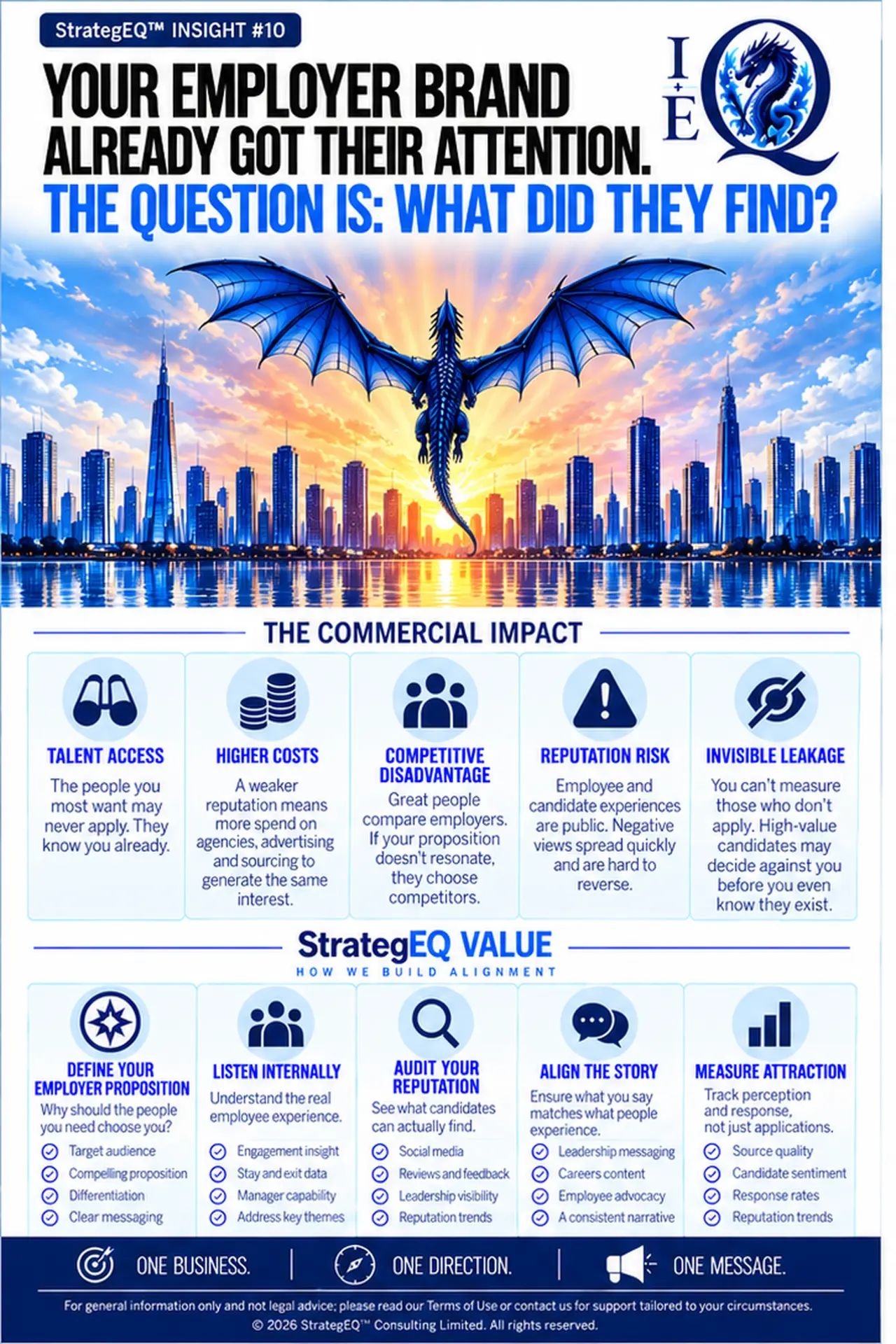
- Talent access — the people you most want may never apply. They may already have formed an opinion before you know they exist.
- Higher costs — a weaker reputation can mean more agency, advertising and sourcing spend to generate the same level of interest.
- Competitive position — great people compare employers. If your proposition does not resonate, they choose competitors.
- Reputation risk — employee and candidate experiences are public. Negative patterns travel quickly and can be difficult to reverse.
- Invisible leakage — you can measure candidates who enter the funnel; you rarely see the high-value people who quietly decide against you.
Employer brand is therefore not a recruitment marketing exercise. It affects the organisation’s ability to access and retain the capability required to execute its strategy.
YOUR EMPLOYER BRAND IS ALREADY PUBLIC
Organisations used to have considerably more control over the employment story they presented.
Not anymore.
Candidates can triangulate the evidence. They can compare the polished careers page with Glassdoor reviews, corporate values with employee commentary and leadership messaging with what their network tells them.
Your employer brand is being shaped every day by:
- the experience of current employees;
- what former employees say after leaving;
- the quality and consistency of management;
- how people are treated during difficult moments;
- what candidates experience when interacting with the organisation;
- leadership visibility and credibility;
- social media, reviews and professional networks.
That makes employer brand difficult to manufacture — and that is a good thing.
A sophisticated campaign cannot sustainably compensate for a poor employee experience.
START INSIDE THE BUSINESS
If you want people outside the organisation to believe it is somewhere worth joining, give the people already inside it reasons to believe it is somewhere worth staying.
Nurture the team.
Listen to employee feedback. Develop managers. Understand regrettable attrition. Examine recurring themes in exit data. Deal with issues rather than polishing the external narrative around them. Treat people properly when they leave as well as when they join.
Former employees do not stop influencing your employer brand when their employment ends. In many cases, they become one of its most credible sources.
The goal is not perfect reviews. No organisation is right for everybody, and an implausibly polished employer brand can undermine credibility rather than strengthen it.
The goal is alignment between proposition and reality.
KNOW WHO YOU NEED TO ATTRACT
Employer brand should not try to make everybody want to work for you.
Ask a more commercial question: who does the business need to attract in order to deliver its strategy?
Understand what those people value, what alternatives they have and what might persuade them to move from somewhere they are already successful.
Then look at your organisation through their eyes. Would the opportunity interest them? Does your leadership inspire confidence? Can they understand where the business is going? Do your employees reinforce the story you are telling? Does your external presence give them a reason to engage?
THE COMMERCIAL UPSIDE
A credible employer brand reduces friction before recruitment even begins.
It can increase access to passive talent, improve outbound response, strengthen candidate confidence, support offer conversion and reduce the amount of persuasion required to fill critical roles.
More importantly, when the external proposition reflects the internal experience, it supports retention as well as attraction.
Employee experience → Reputation → Attraction → Better alignment → Retention → Stronger reputation.
StrategEQ VALUE — HOW WE BUILD ALIGNMENT
StrategEQ helps organisations understand the employer proposition they are actually taking to market — not simply the one written on the careers page.
- Define the employer proposition — establish why the people the business needs should choose you.
- Listen internally — use engagement, retention, employee feedback and exit insight to understand organisational reality.
- Audit external reputation — examine what candidates can actually discover through social media, reviews, networks and public information.
- Align the story — create consistency between leadership messaging, employee experience and recruitment communication.
- Measure attraction — track response, source quality, candidate sentiment and reputation trends rather than applications alone.
Your employer brand is not what you say about your organisation.
It is what the people you want to hire already think they know about you.