
Approx. 5-minute read
Don’t Assume It Doesn’t Apply to You
If you run a startup or scale-up that has never recognised a trade union, this may feel like legislation aimed at somebody else. That assumption could leave you unnecessarily exposed.
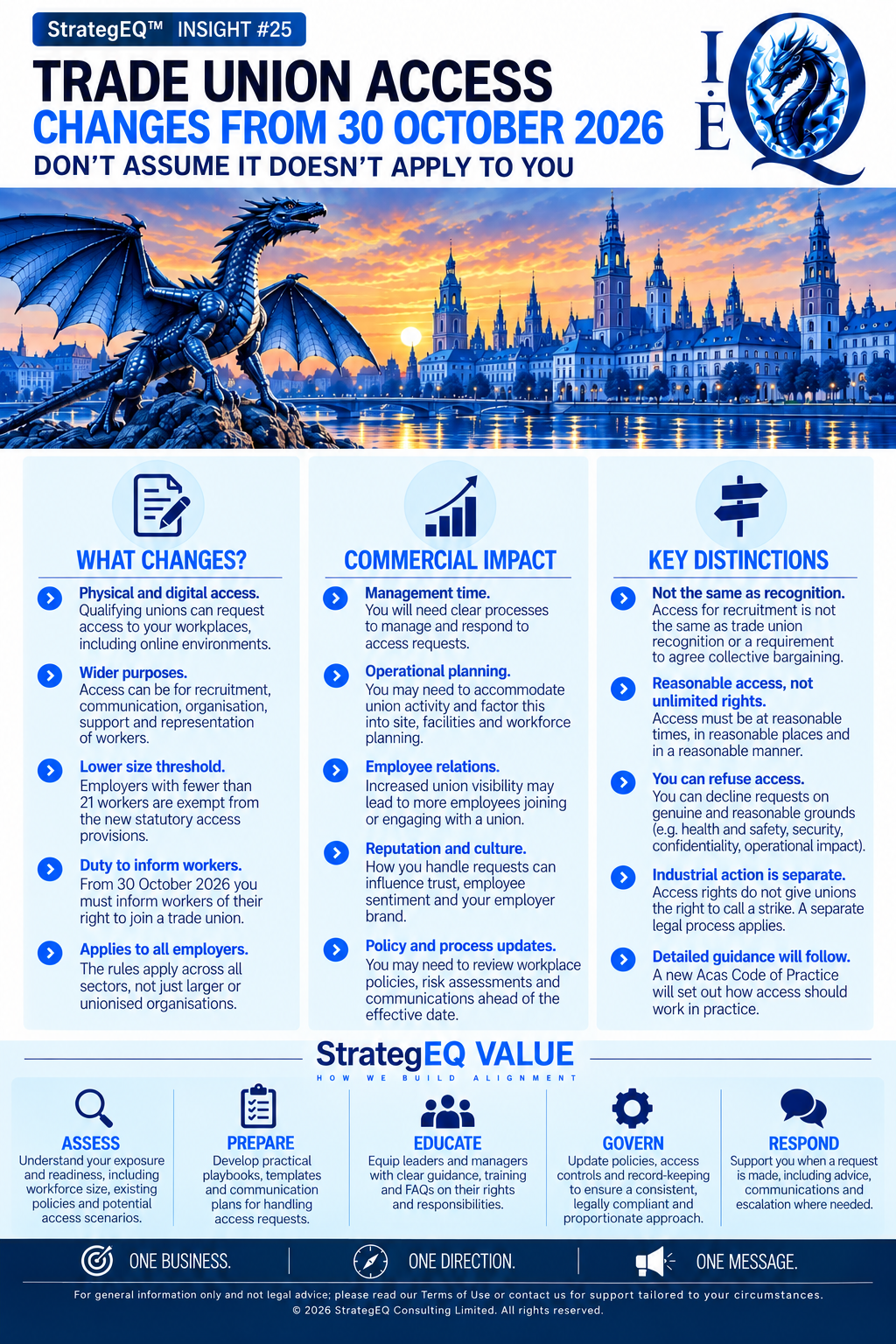
From 30 October 2026, changes to trade union access create practical considerations for companies that have historically regarded themselves as non-unionised. Employers with fewer than 21 workers across all workplaces are exempt from the new statutory access provisions, but growing companies need to understand when that threshold is relevant and what the wider changes mean as they scale.
The commercial risk is not that every startup suddenly needs an industrial-relations strategy. It is that an access request, employee query or increase in union activity arrives and nobody knows what it means, who owns it or how to respond. An unprepared response can consume founder and management time, create inconsistent communications, damage workforce confidence and turn something manageable into unnecessary conflict.
The objective is not to build infrastructure for a problem you do not have. It is to understand enough to respond correctly if you do.
WHAT THIS INSIGHT IS — AND ISN’T
This Insight is not intended to explain everything you need to know about UK industrial relations law. The focus is much narrower: what changes from 30 October 2026, why it matters to companies that have traditionally considered themselves non-unionised and what they should do now.
You may already employ trade union members without considering yourself a unionised company. You may not even know they are members. Employees can already belong to a union their employer does not recognise, and somebody may join your company already belonging to a broad cross-sector union and, subject to that union’s rules, remain a member after changing employer.
None of that is new. What changes from 30 October 2026 is access.
Keep four distinctions in mind: • Membership already exists. • Access is changing. • Recognition is separate. • Industrial action is separate again.
WHAT DOES ACCESS ACTUALLY MEAN?
Under the new statutory framework, qualifying independent trade unions can formally request physical workplace access, communication with workers including digital communication, or both. Permitted purposes include meeting, supporting, representing, recruiting and organising workers, whether or not they are already union members, and facilitating collective bargaining. The statutory access purposes do not include organising industrial action.
This does not mean a union representative can simply arrive at reception and walk around the office. There is a statutory request and response process. Employers and unions can agree access arrangements and, where agreement cannot be reached, the Central Arbitration Committee can become involved. Access should not unreasonably interfere with the employer’s business.
Access does not automatically equal recognition.
DON’T GO LOOKING FOR UNION MEMBERS
Preparation does not mean identifying who your union members are. Do not introduce union-membership questions into recruitment, promotion or talent processes or attempt to build an internal map of who belongs to which union.
Trade union membership already carries legal protection. The company needs to understand its process, not profile its workforce. Managers should understand that membership does not mean the employer recognises that union, and it should not adversely influence recruitment, promotion, development or other employment decisions.
WHAT ABOUT PAID TIME?
Simply joining a union does not create a general entitlement to undertake union activity on paid company time.
Broadly: • representatives of an independent union recognised by the employer can have statutory rights to reasonable paid time off for qualifying union duties and relevant training; • members of a recognised independent union can have rights to reasonable time off for qualifying union activities; • there is generally no statutory requirement to pay for time taken for union activities, although an employer can choose to do so; and • industrial action is separate again.
Workplace access therefore does not automatically mean collective recognition or create a general right to paid facility time. Establish which right is actually being exercised before deciding how time should be treated.
COULD THIS LEAD TO INDUSTRIAL ACTION?
Potentially, but membership alone does not mean a union can simply tell an employee to stop working whenever it chooses.
Industrial action is a separate part of the framework. There needs to be a relevant trade dispute and the union must follow the applicable statutory process, including balloting and notification requirements.
A technology startup might employ 50 people with several members of the same union within its software engineering team. A dispute could arise concerning that group’s pay or working conditions. The fact that other functions and most employees are not union members does not automatically make union involvement irrelevant. Equally, several employees belonging to the same union does not automatically give that union collective bargaining rights across the whole company.
WHAT SHOULD A STARTUP OR SCALE-UP DO NOW?
Keep it proportionate. Consider: • whether the new access provisions apply to you, including the exemption for employers with fewer than 21 workers across all workplaces; • who would receive and own a union access request; • how Reception, managers and shared inboxes would escalate one; • when People, Legal and senior leadership should become involved; • what physical access could reasonably mean in your workplace; • how digital or communications access would be managed; • confidentiality, security, customer and data considerations; • whether managers understand existing accompaniment rights; • whether policies accurately reflect lawful trade union membership and activity; • what managers should not ask employees about union membership; • how paid and unpaid time-off questions would be assessed; and • how the company would communicate calmly with employees if union activity increased.
From 30 October 2026, employers will also have a new duty to inform workers of their right to join a trade union, alongside the strengthened access regime and new rights and protections for trade union representatives.
THE COMMERCIAL TEST
A startup or scale-up may never recognise a trade union, receive an access request or experience industrial action. That is not a reason to build unnecessary infrastructure.
But “we aren’t unionised” is no longer a sensible reason for having no understanding of the framework.
Your employees may already be union members. That is not new and does not automatically change your relationship with your workforce. What changes from 30 October 2026 is the access framework.
Understand the distinction. Educate managers. Decide who owns a request. Protect employees’ existing rights and respond to what is actually happening rather than what you fear it might mean.
Membership already exists. Access is changing. Recognition is separate. Industrial action is separate again.
Preparation gives you control of the process. Ignoring it until something happens gives the process control of you.